...years ago a revelation came to me of God, as the most misunderstood Being in the universe; a God of infinite love, patience and desire to help and to save; and this revelation has led me into all the wonderful truths I have since preached.
- George E. Fifield - From the Sermon "Eternal Punishment"
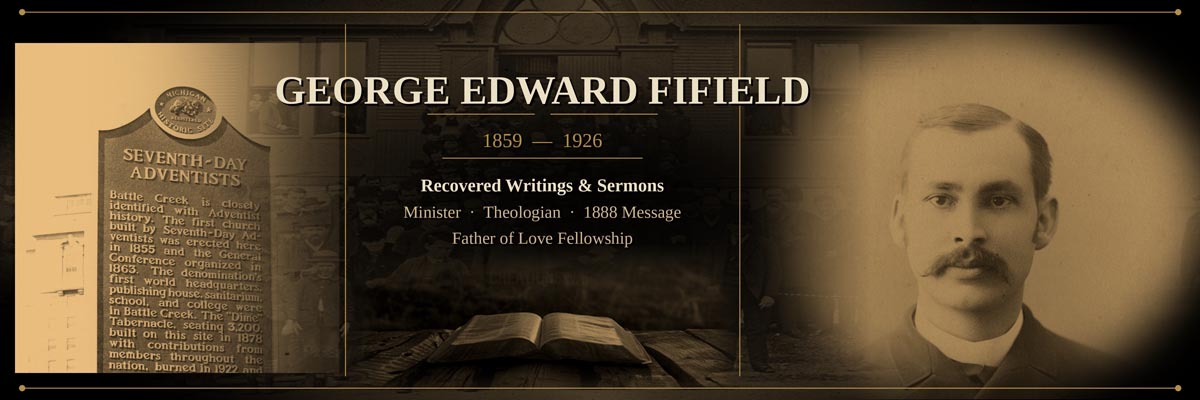
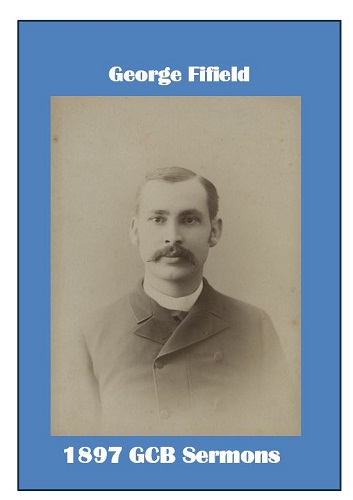
Fifield was born on March 18, 1859, in Nashua, New Hampshire. His childhood was marked by deep tragedy; his mother died of typhoid fever when he was an infant, and his father died of tuberculosis in a Union hospital during the American Civil War in 1865.
Orphaned at a young age, George and his older sister were raised by their maternal grandparents in Merrimack, New Hampshire. His grandfather had broken away from the Methodist Church over the issue of slavery, followed the Millerite movement, and eventually joined the Seventh-day Adventist (SDA) church around 1866. Raised in this environment, George deeply embraced the Adventist faith.
By the early 1880s, Fifield had entered the ministry, and his name began appearing regularly in the Advent Review and Sabbath Herald. He quickly gained a reputation as a highly sought-after evangelist, lecturer, and camp meeting speaker across North America.
Building on the messages of Elders Waggoner and Jones who delivered the 1888 Message, Fifield expanded these principles over the following decades in a number of books and sermons.
Taking Waggoner's lead, Fifield argued passionately against what he called a "pagan conception of sacrifice"—the idea that God was an angry deity whose wrath needed to be appeased or propitiated by the blood of Christ. Instead, he taught that the cross was not Christ reconciling God to the world, but God in Christ reconciling the world to Himself by revealing His unconditional love.
While Fifield's Christ-centered, love-focused message was celebrated by some who rejoiced in the post-1888 righteousness by faith revival, the Adventist church increasingly pushed him to the periphery of the church.
In the early 1900s, Fifield was disconnected from the Seventh-day Adventist denomination. Seeking a faith tradition that honored the seventh-day Sabbath but allowed for greater theological latitude on other doctrines, he aligned with the Seventh Day Baptists. He spent his remaining years serving successfully as a pastor within their conference, including acting as the pastor for the Seventh Day Baptist church in Chicago, Illinois.
He continued to write and preach on his favorite theme—transformation through the crucifixion and resurrection of Christ—until his death in 1926.
The Father of Love movement consider Elder George Fifield to be one of their most prominent pioneers in the post 1888 message of Righteousness by Faith. His legacy reveals the truth of where Adventism should have walked but chose not to. We would like to especially thank Patrick Irving for the discovery of many of his works in the Seventh Day Baptist Archive. And we thank the Seventh Day Baptist Church for preseving his legacy in his books and sermons.
A song inspired by a poem by Elder George Fifield