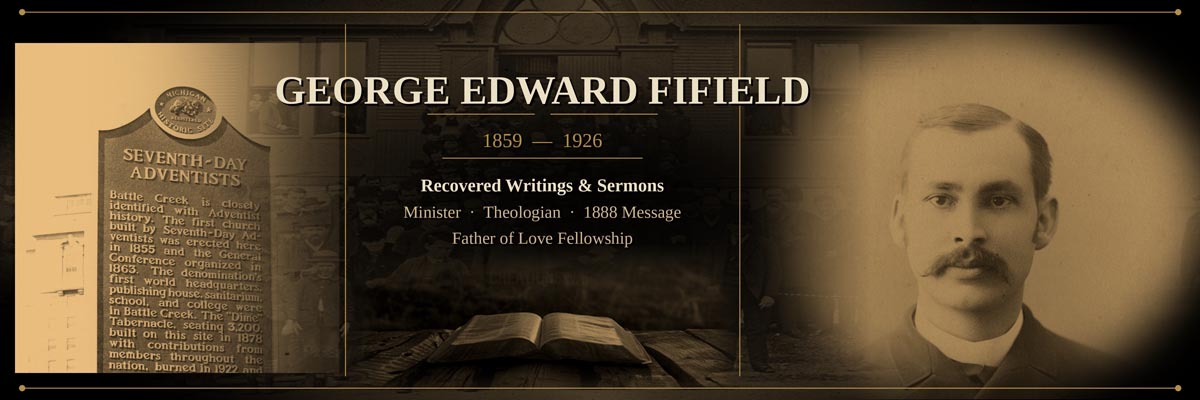
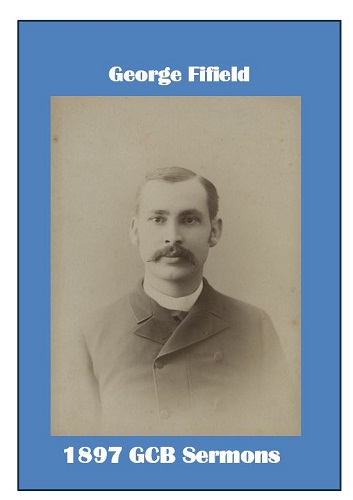
George E. Fifield • November 5, 1896 • American Sentinel, Vol. 11, No. 44
"THERE is no power but of God." Rom. 13:1.
This is an expression of the largest possible faith—a faith that can, under all circumstances, rest lovingly, tenderly, and trustingly in the Everlasting Arms.
Though in these high matters, staggering, blindly, even science it would seem has been slowly approaching this same sublime conclusion.
We are taught that the universe is entirely composed of matter and force. Matter is defined as "everything that occupies space, or that has length, breadth, and thickness;" force, as "whatever produces or opposes motion in matter."—"Wells' Natural Philosophy."
But One Force in Nature.
Years ago it was supposed that there were several forces, each independent of the other. They were enumerated as light, heat, electricity, magnetism, the attraction of gravitation, the molecular forces of attraction and repulsion, and the vital force. Then came the great scientific discovery of the truth of the "correlation of forces." Electricity it was found could be transmuted into heat and light, and to some degree even into vital force. Heat and light were found to be only manifestations of the molecular forces, and gravitation, being transmutable into electricity, was also transmutable into each of the others. So it was seen that there were not several forces, but only one force acting in several different ways.
Treading on the heels of this truth came the teaching by Balfour Stewart, and others, on the "conservation of energy." It was found that force, like matter, was absolutely indestructible and therefore unchangeable in quantity.
If A represents light, and B heat, and C electricity, etc., there may be more of A at one time than at another, for there may be less of B or C, and they are transmutable; but the sum of A plus B plus C, etc., is always equal.
Here then is the great truth: there is only one force or power in the universe, and that power or force is absolutely unchangeable, though manifested in countless millions of ways by its effect upon matter.
Whether we call it gravitation, as it holds the worlds in their courses, or causes the o'er weary sparrow to fall to the ground; or electricity as it runs our machinery, and lights and perhaps heats our houses, or makes the earth tremble as it rends the storm cloud; or vital force as it takes of the dead inanimate mineral matter and grows the countless forms of beauty in the vegetable kingdom; or of the vegetable matter, to grow the animal forms—whatever its name or its manifestations, it is one and the same force, and unchangeable.
Science Cannot Answer.
Why does not science lift her eyes to the heights and ask one more question? We want to know if this infinite and unchanging power be merely dead and impersonal, or if it be living and loving. We ask of this same science, What is electricity? What is gravitation? What is magnetism? What is the vital force? She reluctantly shakes her head or gives as the only answer that they are only different manifestations of the one unchanging power.
Well, then, if men cannot answer let them listen reverently and silently while God answers through his inspired teachers. "There is no power but of God;" and God is manifest through Christ, for he said, "All power is given unto me in heaven and in earth."
By him, Christ, also, God made the worlds, and he is before all things, and by him all things consist or hold together. It is he that upholdeth all things by the word of his power.
"Lift up your eyes on high, and behold who hath created these things, that bringeth out their host by number: he calleth them all by names by the greatness of his might, for that he is strong in power; not one failed." "Why expect thou, O Jacob, and speakest, O Israel, my way is hid from the Lord, and my judgment is passed over from my God?" Isa. 40:26, 27. See also Heb. 1:1-3 and Col. 1:17.
Power Living, Loving, Personal.
Here we see that that infinite and unchanging power of which science speaks is not dead but living, loving and personal. This power is God, of whom all the great and good have spoken, and to whom their hearts have turned as the flowers to the sun—God "in whom we live and move and have our being," and who "is not far from every one of us,"—God who upholdeth all things by the word of his loving power—upholdeth the suns and worlds, and upholdeth the sparrow, upholdeth the various kingdoms of earth as long as he wills, upholdeth also my soul. "Why expect thou, O Jacob, and speakest, O Israel, my way is hid from the Lord, and my judgment is passed over from my God?" "Hast thou not known, hast thou not heard that the everlasting God, the Lord, the Creator of the ends of the earth, fainteth not, neither is weary? there is no searching of his understanding?"
That Were Atheism.
The man who talks of a chance world, or a chance universe, is an athcist, and Christian people are horrified at the thought. But what about my little world with its joys and sorrows, its pleasures, and multitudinous cares! What about the government or kingdom in which I may live,—yea, what about it with its persecution and political scheming, its feeble efforts at justice, and its many mistakes? Are my little world and the nation in which I live run by chance? Ah! no, for this too were atheism, for atheism is "God outness in human life." Even Nebuchadnezzar of old had to learn that the "Most High releth in the kingdom of men, and giveth it to whomever he will." And Job, after much experience, said, "He knoweth the way that I take, and when he hath tried me I shall come forth as gold," "For I know that my Redeemer liveth, . . and though after my skin worms destroy this body, yet in my flesh shall I see God."
It is thus that through the varied good and ill of human governments and human life, God rules ever in love to work out that which is best. Says D'Aubigne: "The true God, willing to impress on the minds of all nations that he reigns continually on earth, gave with this intent a bodily form to this sovereignty in the midst of Israel. A visible theocracy was appointed to exist once upon the earth that it might unceasingly remind us of that invisible theocracy which shall forever govern the world."
It was the glory of this invisible, though divine, kingdom that burst for a moment upon Nebuchadnezzar when he exclaimed, "How great are his signs! and how mighty are his wonders! his kingdom is an everlasting kingdom, and his dominion is from generation to generation." He who was king over the lesser kings, and who had, in his pride, thought himself head over all, had caught a glimpse of the "King Eternal," in whose mighty kingdom he and all other earthly princes were only willing or unwilling vassals.
How Can God Tolerate Evil?
But, says one, How can it be that God, who is infinitely good, is really ruling above all this apparent chaos of evils? God had to permit the possibility of evil in order that real good might be possible, for the possibility of righteousness is also the possibility of unrighteousness or sin. So evil came. Now, God, while allowing to all perfect freedom of action, and therefore the freedom to develop characters both good and bad, so overrules all as to make even the evil work together for the good of all who love him. "He maketh the wrath of man" and even of devils "to praise him, and the remainder of wrath," i. e., all that he cannot make work for good, "will he restrain."
God says: "I make peace and create evil; I the Lord do all these things." This text the writer could never understand until he saw that the word "create" here means to choose for the purpose of forming and molding into his divine ideal of good. How splendid then is the text. The creative power of infinite love is above not good only, but also above all the evil in the universe, in the world, in the nation, and in the environment of my little life,—and it is there for the purpose of using all to bring out the divine ideal of beauty.
Truly there is no power but of God,—the God in whom we live and move and have our being. Even the devil and wicked men live only by his power. They seek to turn the power of even the life of God against himself, and God permits them to make the foolish and wicked attempt for a time, because out of even this he can bring forth good.
Christ Triumphed on the Cross.
Satan thought he got a great victory over God when he crucified Christ, but inspiration tells us that Christ triumphed over the principalities and power of Satan in that very cross. If the place where Satan thought he got his greatest victory over God was really the place where God got his greatest victory over Satan and evil,—a victory that is to redeem the world and the universe, what about the lesser victories that Satan has thought to gain over God? What about the wrongs and injustices of other governments, and the persecution of other martyrs? These too are only apparent victories for evil, but real victories for the good, for all minister to the final and universal triumph, which is soon to be, of love over hatred, and of truth over falsehood. Lowell well says:—
Truth forever on the scaffold,
Wrong forever on the throne;—
Yet that scaffold swaps the future;
And behind the dim unknown,
Standeth God within the shadow,
Keeping watch above his own.
All men do not see God within the shadow, but he is there, and there is no power but of him. Paul was not a prisoner of Nero, but of Jesus Christ. For the trusting one there is no prison only where Love holds the keys. Such souls can rest lovingly and peacefully in the Everlasting Arms, trusting the promise, "As thy day so shall thy strength be." Wicked men and wicked princes may do their worst, and nations may conspire as of old against the Lord and against his anointed, but God is over all. Some day the souls whom God shall finally lift to the mountain summit with him will see that his purposes of Love, in spite of all the evil, and without oscillation, and without rebounding, have been going steadily, grandly, onward through the centuries to the sublime realization.
They then will see what faith so grandly perceived eighteen long centuries ago, that "there is no power but of God."