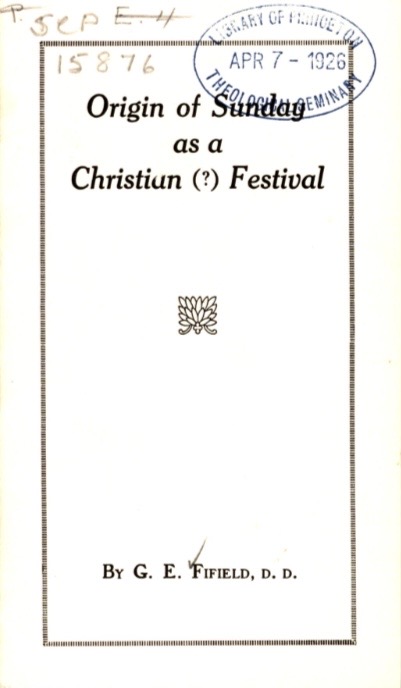
 The original printing of this pamphlet included a brief prefatory note by Ahva J. C. Bond, Leader in Sabbath Promotion for the American Sabbath Tract Society. That note has been omitted from the present edition as it falls outside the scope of this collection. Fifield's text follows in full. * * *
All admit that the seventh day of the week was the Sabbath prior to the time of Jesus and the apostles. If, therefore, the first day Sabbath, or “Lord’s Day,” so called, has any divine sanction whatsoever, it must have acquired it from Christ while he was on the earth; the record of this must be in the New Testament.
The first day of the week is mentioned but eight times in the New Testament. It is never, in these mentionings, called the Sabbath, the Lord’s Day, or by any sacred title whatsoever.
Six of these mentionings refer to the same day—the day when, after his resurrection, Christ showed himself to his disciples in order to have witnesses to the fact that he was risen. See Acts 10: 40, 41. These Scriptures, although written years after the resurrection, plainly tell us that the first day of the week was not the Sabbath, but the day after the Sabbath.
The seventh text that mentions the first day of the week is Acts 20: 7. It gives the only record in the New Testament of a religious meeting held on that day. This meeting was at Troas, and was held on the evening after the Sabbath, that is, on our Saturday night; and so, as people reckon time now, not on Sunday at all. Paul’s traveling companions, who with him had been there a week, waited until after the Sabbath was over and then “went before to ship, and sailed unto Assos, there intending to take in Paul: for so had he appointed, minding himself to go afoot.” Acts 20: 13. Paul remained to hold a final farewell meeting on what is now called Saturday night, and then on Sunday walked nineteen and a half miles across the isthmus to meet the others at Assos. Conybeare and Howson, in their Life and Epistles of St. Paul say plainly of this meeting, “It was on the evening that succeeded the Jewish Sabbath,” and they picture Paul on his lonely Sunday walk next day. So this text, so far from supporting the Sunday Sabbath, or Lord’s Day theory, shows clearly that they did not observe that day as sacred, but held it as a common working day.
There remains only one more mention of the first day of the week in the New Testament. 1 Corinthians 16: 2. “Upon the first day of the week let every one of you lay by him in store, as God hath prospered him, that there be no gatherings when I come.” This does not imply a religious service held, for it is clearly not a public collection, but “a laying by him in store,” to put into the collection when the apostle comes. Concerning this text Kitto says: “The regulation has been supposed to have reference to the tenets of the Jewish converts, who considered it unlawful to touch money on the Sabbath. In consideration for them, therefore, the apostle directed this work to be done on the following day, on which secular business was lawful; or, as Cocceius observes, they regarded the day (Sunday) not as a feast, but as a working day.” Kitto’s Cyclopedia of Biblical Literature, (New York American Book Exchange, 1880) article “Lord’s Day.”
This last text in support of Sunday sacredness, therefore, disappears entirely, and, worse yet, turns into a positive proof that they counted Sunday not sacred at all, but merely as a “working day.”
How different it is with the true Christian Sabbath—the Sabbath of the Lord, created and consecrated by Christ as the consummation of Creation itself, set apart from the other six days of the week by Christ, himself, each week for forty years, in the giving of the manna. “I,” said Christ, “am that bread which came down from heaven.” The Sabbath was enshrined by Christ in the very heart of the divine law; for said Stephen, speaking of Christ, “This is he that was in the church in the wilderness with the angel who spake to him in Mount Sinai, and with our fathers who received the lively oracles to give unto us.” No wonder Jesus said, “Therefore the Son of man is Lord even of the Sabbath day.” The seventh day Sabbath is, therefore, the Christian Sabbath—the Sabbath of the Lord.
When, then, and under what influences did Sunday come to take the place of the Sabbath in the Christian Church?
Chamber’s Encyclopedia (W. and R. Chambers, London, 1866) helps us to answer the question thus:
At what date the Sunday, or first day of the week, began to be generally used by Christians as a stated time for religious meetings, we have no definite information, either in the New Testament, or in the writings of the fathers of the Church. By none of the fathers before the fourth century is it identified with the Sabbath, nor is the duty of observing it grounded by them either on the fourth commandment, or on the precept or example of Jesus or his apostles.—Article “Sabbath.”
Kitto also adds his testimony to prove that the first day of the week was not observed in the Apostolic Church. He says:
We will merely remark that, though in later times we find considerable reference to a sort of consecration of the day, it does not seem at any period of the ancient church to have assumed the form of such an observance as some modern religious communities have contended for. Nor do these writers in any instance pretend to allege any divine command, or even apostolic practice, in support of it. (Italics his)—Cyclopaedia of Biblical Literature, article “Lord’s Day.”
Verily the great church historian, Neander, speaks the truth, when he says:
The festival of Sunday, like all other festivals, was always only a human ordinance, and it was far from the intention of the apostles, to establish a divine command in this respect; far from them and from the early Apostolic Church to transfer the laws of Sabbath to Sunday.—Neander’s Church History translated by H. J. Rose, (James M. Campbell & Co., Philadelphia, 1843.) page 184.
As to the observance of the seventh day Christian Sabbath in the early church, these same writers speak as follows:
It is however clear from several passages in the New Testament that it (the Sabbath) continued to be observed as heretofore. . . . . Our Savior adds, “Therefore the Son of man is Lord even of the Sabbath day”; which is on all hands agreed to mean that he had power to abrogate it partially or wholly, if he saw fit; and it is admitted that he did not then think fit to exercise this power.—Kitto’s Cyclopaedia Biblical Literature, article, “Sabbath.”
Chamber’s Encyclopedia here reminds one of the story of the boy who was selling a blind horse. He seemed to be very careful to tell all the defects of the horse, mentioning especially that he was totally blind in one eye. The customer was pleased and closed the deal for the horse. After the sale was consummated the buyer asked, “Do you know anything else the matter with this horse; come now, tell me if you do, for the horse is sold, and it will do you no harm.” “Yes,” said the boy, “there is one other little thing; the horse is totally blind also in the other eye.”
So here, Chamber’s Encyclopedia, article “Sabbath,” says:
On no occasion does he [Jesus] seem to have sanctioned the performance of real work on the seventh day, unless it was demanded by some higher duty than that of bodily rest.
For several years after the death of Jesus, the Church included none but Jews, and by these the Sabbath and other Mosaic rites continued to be observed as before. . . . .
That he [Paul] never taught the Jewish Christians to abandon the observance of the law, but, on the contrary, continued to the end to observe it himself—as appears from Acts 25: 8; 28: 17; Philip. 3: 6—are facts of which different explanations have been given by theologians.
In the eastern churches, where the proportion of Jews was greater than in the west, the Sabbath continued to be observed till the fifth century. . . . Down to the present time, however, Sabbath keeping and other Jewish rites continue to be practiced along with Christian observances by the Christians of Abyssinia.
In other countries, also, many of the Gentile Christians seem to have anciently observed the Sabbath.
Thus by degrees the truth is out. First, Christ and his apostles kept the Sabbath and taught it. Second, the Jewish Christians did so. Third, in the East, that is in Palestine and Asia, the home of Christianity, both Jewish and Gentile Christians continued to keep the seventh day Sabbath until the fifth century, and some, even until now. Last, in other countries even the Gentile Christians for a long time continued to keep the Sabbath. The whole story is out at last—the other eye of the theory of Sunday sacredness, is blind, also.
Having learned something of the time when Sunday keeping began to take the place of Sabbath keeping in the Christian Church, again we ask, what were the influences, pagan or Christian, that tended to bring about this change?
Paul, speaking in the Spirit, foretold a great apostacy, when grievous wolves should come in, not sparing the flock; when the people’s ears should be turned away from the truth, and turned unto fables; when the man of sin should exalt himself above all that is called God, or that is worshiped, so he, as god, should sit in the temple of God, the church, showing himself that he is God.
These prophecies were wonderfully and speedily fulfilled. Dowling, in his History of Romanism, bears the following testimony:
There is scarcely anything that strikes the mind of the careful student of ecclesiastical history with more surprise than the comparatively early period at which many of the corruptions of Christianity which are embodied in the Romish system took their rise.—Book 2, chapter 1, sec. 1.
Writing of the second century the historian Mosheim says:
Among the Greeks, and the people of the East, nothing was held more sacred than what were called the “mysteries” (of which Paul wrote, “It is a shame even to speak of the things that are done of them in secret”).
This circumstance led the Christians, in order to impart dignity to their religion, to say that they also had similar mysteries, and they not only applied the terms used in the pagan mysteries to the Christian institutions, but they gradually introduced also the rites which were represented by those terms. A large part, therefore, of the Christian observances and institutions, even of this century, had the aspect of pagan mysteries.—Mosheim, (translated by James Murdock, D. D., Harper Brothers, 1842.) century 2, part 2, chap 4, par. 5.
Again he says:
An enormous train of superstitions was gradually substituted for true religion, and genuine piety.
Henry Thomas Buckle says:
The superstitions of (pagan) Europe, instead of being diminished, were only turned into a fresh channel. The new religion (Christianity) was corrupted by the old follies. The adoration of idols was succeeded by the adoration of saints; the worship of the Virgin was substituted for the worship of Cybele; pagan ceremonies were established in Christian churches; not only the mummeries of idolatry but likewise its doctrines were quickly added, and were incorporated and worked into the spirit of the new religion, until after the lapse of a few generations Christianity exhibited so grotesque and hideous a form that its best features were lost and the lineaments of its early loveliness altogether destroyed.
After some centuries were passed away, Christianity slowly emerged from these corruptions, many of which, however, even the most civilized countries have not yet been able to throw off.—History Civilization, (D. Appleton and Company, New York, 1888.) vol. 1, p. 188.
Draper well says:
There is solemnity in the truthful accusation which Faustus (a pagan philosopher) makes to Augustine (a Christian (?) father) “You have substituted your agape for the sacrifices of the pagans; for their idols, your martyrs, whom you serve with the very same honors. You appease the shades of the dead with wine, and feasts; you celebrate the solemn festivals of the Gentiles, their calends, and their solstices; and as to their manners, those you have retained without any alterations. Nothing distinguishes you from the pagans, except that you hold your assemblies apart from them.—Draper’s Intellectual Development of Europe, (Harper Brothers, New York, 1876.) vol. 1, p. 310.
All this helps us to understand, and gives great force to Dowling’s words:
The Bible, I say, the Bible only, is the religion of the Protestants. Nor is it of any account in the estimation of a genuine Protestant how early a doctrine originated, if it is not found in the Bible. . . . . He who receives a single doctrine from the mere authority of tradition… by so doing steps down from the Protestant Rock, passes over the line that separates Protestantism from popery, and can give no reason why he should not receive all the earlier doctrines and ceremonies of Romanism.—Dowling’s History of Romanism, book 2, chap. 1.
We are now approaching the time of Constantine, and will see what his influence was on this institution, and why.
Beginning with Diocletian, just prior to the time of Constantine, a change was made in the form of government, which was intended to make stable the Roman institutions in spite of the death and frequent assassination of emperors. Unintentionally this resulted in dividing the empire into six parts, each ruled by a Cæsar. Each Cæsar was independent in his own territory, and coequally and cojointly they were to rule over the general interests of the Roman world. Constantine was one of these Cæsars.
But Constantine knew that in all these departments of the empire there were multitudes of Christians made sore by the ten years’ terrible persecution under Diocletian; many of these were soldiers in the armies of the five other Cæsars. Constantine thought he saw a way by favoring the cause of the Christians to eliminate the five other Cæsars and unite the whole Roman world under his authority. He was helped in this by the fact that some of the other Cæsars had helped Diocletian make the persecution of Christians most fierce, while Constantius Chlorus, the father of Constantine, had, in his treatment of the Christians, been the mildest of them all.
History justified Constantine’s political judgment in this matter. His choice accomplished the foreseen results. His conversion was thus purely a political one.
Before this conversion he was an enthusiastic sun worshiper. Gibbon says of him then:
The devotion of Constantine was more peculiarly directed to the genius of the sun, the Apollo of the Greek and Roman mythology. . . . The altar of Apollo was crowned with the votive offerings of Constantine. . . . The sun was universally celebrated as his invincible guide and protector.—(Decline and Fall of the Roman Empire.) Chap. 20, par. 3.
As might be expected, the Britannica, (edition of 1894) article “Constantine,” says of him after his conversion:
At best he was but half Christian, half pagan, a man who sought to combine the worship of Christ with the worship of Apollo, the sun, having the name of the one, and the image of the other engraved on the opposite sides of his coins.
The motto on the sacred standard carried before his armies, the prayers he taught his soldiers to pray, and the formula went through with in the dedication of the new city Constantinople, were all so carefully and adroitly worded as to pass with the pious pagans as good paganism, and with the already contaminated sun-worshiping Christians, as good Christianity. Not only so, but at the same time he was Pontifex Maximus of the pagan church, and supreme bishop of externals in the Christian Church; and when he died the pagans hastened to deify him, and the Christians to canonize him.
Of his death Dean Stanley says:
So passed away the first Christian emperor, the first defender of the faith—the first imperial patron of the papal see, and of the whole eastern church—the first founder of the holy places—Pagan and Christian, orthodox and heretical, liberal and fanatical, not to be imitated or admired, but much to be remembered, and deeply to be studied.—History of the Eastern Church, (Scribner, Armstrong and Company, 1873.) page 320.
The reader will readily see that Constantine was the most consummate politician the world has ever known. He rode two horses for forty years and never lost his balance once.
Dean Stanley informs us that the same pago-Christian motives which inspired all his acts controlled also his Sunday legislation:
The retention of the old pagan name of “Dies Solis” or “Sunday” for the weekly Christian festival, is, in great measure, owing to the union of pagan and Christian sentiment with which the first day of the week was recommended by Constantine to his subjects, pagan and Christian alike, as the “venerable day of the sun.” His decree regulating its observance has been justly called a new era in the history of the Lord’s Day.
It was his mode of harmonizing the discordant religions of his empire under one common institution.—History of the Eastern Church, p. 291.
As the reader knows “the discordant religions of the empire” were paganism and Christianity, harmonized under this “one common institution,” by the already paganizing Christians becoming pagan enough to accept this Sunday in the place of the Sabbath of the Lord—a day which they have ever since been unsuccessfully seeking to make Christian.
This first Sunday law, here referred to, was made A. D. 321, while Constantine was yet openly pagan. It reads:
“Let all the judges and townspeople, and the occupation of all trades rest on the venerable day of the sun; but let those who are situated in the country freely and at full liberty attend to the duties of agriculture; because it often happens that no other day is so fit for the sowing of corn and the planting of vines, lest by neglecting the proper occasion they should lose the benefits granted by divine bounty.”
This purely pagan edict, is the father of all Christian (?) Sunday laws. At a later period, carried away by the current of his own political ambition, he declared himself a convert to the Church:
Christianity then, or what he was pleased to call by that name, became the law of the land, and the edict of A. D. 321, being unrevoked, was enforced as a Christian ordinance.—Sunday and the Mosaic Sabbath, (R. Goomarige and Son, London.) p. 4.
It may be apropos here to remark that it was after Constantine had this political conversion and became this sort of political Christian, that he roasted his wife Fausta, with whom he had lived forty years, in a steam bath, and murdered his son Crispus, becoming jealous of him because of his popularity with the people. History says of him:
By general consent, he was a worse prince at the close of his reign than at its beginning, when he was little better than a pagan.—Stanley, History Eastern Church, p. 297.
Of the time when Constantine had commanded Arius to be received back into the church at Constantinople, Neander wrote:
It happened on a Sabbath (Saturday) on which day, as well as on Sunday, public worship was held in Constantinople.
This was what Neander wrote, and it is so translated in the 1851 edition. But here is a nice incidental reference to the fact that away down in the fourth century, in the very headquarters of Eastern Christianity, the Christian Sabbath was still being observed along with the coming in of the sun festival. Sunday-keeping Christians do not like this; so in the 1871 edition, a falsehood is told to avoid telling the truth, and this quotation is translated to read: “Arius, was to be solemnly received back to the fellowship of the church, at the celebration of public worship on Sunday in Constantinople.” Vol. 2, p. 385.
Nevertheless on page 298 we are told, “In several of the Eastern Churches, the Sabbath was celebrated nearly after the same manner as Sunday. Church assemblies were held, sermons delivered, and communion celebrated on that day.” On page 301 we read, “First, in the year 425 the exhibition of spectacles on Sunday, and on the principal feast days of the Christian Church were forbidden, in order that the devotion of the faithful might be free from disturbance.”
The reason given is, “Because people collect more to the circus than to the Church.” It sounds quite modern. Neander adds, “In this way the Church received help from the State for the furtherance of her ends.”
We have seen the pagan source of the sun festival. As the Italian historian Gavazzi says: “A pagan flood flowing into the Church, carried with it its customs, practices, and idols.”—Gavazzi’s Lectures, p. 290.
It was this “pagan flood,” and not the Pentecostal shower of the Spirit that swept Sunday observance into the Christian Church.
And being pagan, Sunday first resorted to the pagan principle of external, legal force, repudiating Christ’s great principle of resting his religion solely on the power of truth over the mind, and of love over the heart.
As we have seen, Constantine’s law of A. D. 321, applied only to the “townspeople.”
But it was not till the year A. D. 536, that abstinence from agricultural labor on Sunday was recommended rather than enjoined by an ecclesiastical authority (the third council of Orleans) and this expressly that the people might have more leisure to go to church, and to say their prayers. . . . Nor was it until about the end of the ninth century that the emperor Leo, the philosopher, repealed the exemption of the edict of Constantine.—Chamber’s Encyclopaedia, art. “Sabbath.”
The exemption enjoyed under the edict of Constantine, was that “Those who are situated in the country, may freely and at full liberty attend to the duties of agriculture.”
Thus we see that it was down into the seventh century before the apostatizing, sun-worshiping church recommended men in the country to abstain from Sunday labor; nor was it until nearly the close of the ninth century that this church required such abstinence from Sunday labor.
It was long after this, before men ever dreamed it was wrong to play on Sunday. The Puritans of England, in the seventeenth century, were the first to give the day a strictly Sabbatical character by forbidding all amusements on that day. This they did in direct opposition to the teachings of the English Church.
To thwart this purpose of the Puritans James I enacted his law of “Field Sports on Sunday,” enjoining that after attending church on Sunday morning, the people should be free in the afternoon to enjoy such sports as “dancing, archery, leaping, vaulting, May-games, morris-dances, etc.”
This law was re-enacted by Charles I, and a copy of it sent to all the churches, was ordered to be read in the churches after the morning worship.
The historian Hume says that this was one of the reasons why the Puritans, under Cromwell, uprose and beheaded King Charles.
THE SABBATH IN THE REFORMATION
Carlstadt was a co-worker with Luther. D’Aubigné says that Luther himself admitted that Carlstadt was his superior in learning.—History, reference book 10, p. 315.
Carlstadt observed the seventh day Sabbath, and taught its observance. There are several testimonies to this fact.
Dr. White, Lord Bishop of Ely: “The observance of the seventh day was being revived, in Luther’s time, by Carlstadt.”—Treatise of the Sabbath, p. 8.
“Carlstadt held to the divine authority of the Sabbath from the Old Testament.”—Sear’s Life of Luther, p. 402.
Luther, himself, in his book Against the Celestial Prophets, says: “Indeed, if Carlstadt were to write further about the Sabbath, Sunday would have to give way, and the Sabbath—that is to say, Saturday—must be kept holy.”
Carlstadt’s position was exactly that of the Master who said, “Every plant that my heavenly Father hath not planted, shall be rooted up.” Carlstadt said: “In regard to the ceremonies of the Christian Church, all are to be rejected which have not a warrant in the Bible.” Luther asserted on the contrary, “Whatever is not against the Scripture is for it, and the Scripture for it. Though Christ did not command adoring of the host, so neither hath he forbidden it.” “Not so,” said Carlstadt, “We are bound to the Bible, and no one may decide after the thoughts of his own heart.”—Sear’s Life of Luther, pages 401, 402.
Carlstadt’s position, as against Luther’s, was the final, and the correct position of the Reformation; for the Church could be filled with the dead lumber of old ceremonies that the Bible had not definitely foreseen and forbidden.
“It can not be denied that in many respects Carlstadt was in advance of Luther, and doubtless the Reformation owes him much good for which he has not the credit.”—M’Clintok and Strong’s Cyclopedia, vol. 2, p. 123.
The human mind is like a pendulum, swinging from one extreme to the other. From the Roman Church’s teaching of justification by works of penance, Luther’s mind swung over to the extreme idea of justification by faith without works, which caused him to deny the inspiration of the Epistle of James, calling it “an epistle of straw,” because James said, “Faith without works is dead, being alone.” It was this attitude of the mind of Luther, and of some of the other reformers, that caused him to reject the authority of the true Christian Sabbath. (All references in above paragraphs are taken from Anderson’s “History of the Sabbath,” third edition, 1887.)
THE PRICE THE REFORMATION PAID FOR REJECTING THE SABBATH
Draper says:
Toward the close of Luther’s life it seemed as if there was no other prospect for papal power than total ruin. Yet at this day, out of three hundred millions of Christians, more than half owe allegiance to Rome. Almost as by enchantment the Reformation suddenly ceased to advance. Rome was not only able to check its spread, but even to gain back a portion of what she had lost.—Intellectual Development, vol. 2, p. 216.
At the Council of Trent, called by the Roman Catholic Church, to deal with questions arising out of the Reformation, it was at first an apparent possibility that the council would declare in favor of the reformed doctrines, instead of against them, so profound was the impression made thus far by the teachings of Luther and the other reformers.
The pope’s legate actually wrote to him that there was “a strong tendency to set aside tradition altogether, and to make the Scripture the sole standard of appeal.” The question was debated day by day, until the council was fairly brought to a standstill. Finally the archbishop of Reggio turned the council against the Reformation by the following argument:
The Protestants claim to stand upon the written Word only. They profess to hold the Scripture alone as the standard of faith. They justify their revolt by the plea that the Church has apostatized from the written Word and follows tradition. Now the Protestant’s claim that they stand upon the written Word alone, is not true.
Their profession of holding the Scripture alone as the standard of faith, is false. Proof: The written Word explicitly enjoins the observance of the seventh day as the Sabbath. They do not observe the seventh day, but reject it. If they do truly hold the Scripture alone as the standard, they would be observing the seventh day, as is enjoined in the Scripture throughout. Yet they not only reject the observance of the Sabbath as enjoined in the written Word, but they have adopted, and do practice, the observance of Sunday, for which they have only the tradition of the Church.
Consequently, the claim of “Scripture alone as the standard” fails, and the doctrine of “Scripture and tradition as essential” is fully established, the Protestants, themselves, being judges.—See The proceedings of the Council of Trent, Augsburg Confession, and Encyclopedia Britannica, article “Trent, Council of.”
At this argument, the party that had stood for the Scripture alone, surrendered, and the council at once unanimously condemned Protestantism and the whole Reformation, and at once proceeded to enact stringent decrees to arrest its progress.
It was by this means, and also by the denial of the other cardinal principle of the Reformation, the doctrine of soul-liberty, by an appeal to force, to offset the attacks of Romanism, that the glorious progress of the Reformation was arrested as “by a magic wand.” Then the churches wrote their creeds, and so took the people from the guidance of the spirit of truth and delivered them over to the control and teachings of the organizations, which must ever be ultra conservative. Thus the light of the Sabbath truth did not shine clearly in the sixteenth century.
Doubtless God’s providence was in this as in all things, working even through our mistakes and our failures.
Perhaps, as the prophets seem to indicate, the testing of this special truth is needed in God’s great work “that shall lighten the world with its glory” in the consummation of the age. Shall we be true and ready to be used by him in giving this message to the world at that time!
God grant we may be, and that we may come up then to the help of the Lord against the mighty. This conflict between sun worship and “the wild solar holiday of all pagan times,” on the one hand; and the spiritual worship of God on his consecrated Sabbath day, on the other, is from the beginning of human history; and the victory of truth can not now be long delayed. It is in the triumph of God’s kingdom on earth.