 A L O V I N G T R I B U T E
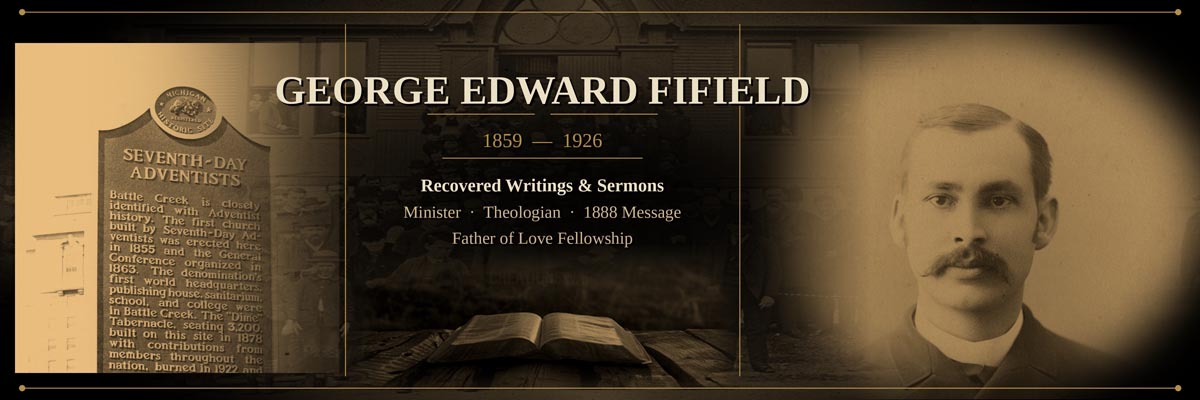
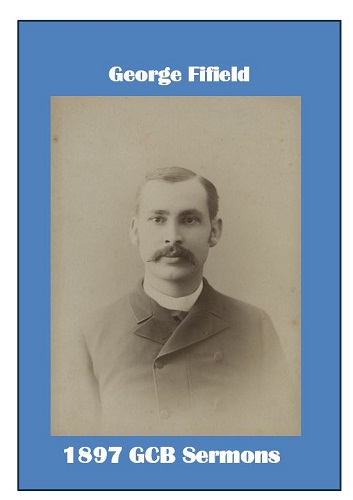
By Mrs. E. E. Wagner—given at Mr. Fifield’s funeral service, August 1, 1926.
We are all grieving and rejoicing today—grieving because we have lost a dear friend and will henceforth be deprived of his blessed ministry,—rejoicing because he has finished his course, having fought a good fight, having kept the faith; rejoicing because he died practically in harness, having been privileged to engage in his beloved work of preaching the Gospel up to the last Sabbath of his life; rejoicing because he was not left to linger in suffering when his work was done.
When my husband died ten years ago, Elder A. T. Jones came all the way from Washington to preach his funeral sermon, and I was so thankful to have some one who had known and loved him to do that for him. Then when Elder Jones himself died a few years ago and I knew that Elder Fifield was going to preach his funeral sermon, I said to him, “I am so glad that some one who knew and loved him is going to speak.” And now on this occasion, having been specially asked to do so, I feel it is a privilege to say a few words as one who knew and loved Elder Fifield.
And yet I speak not as one, but as the representative of many here and in other parts of the world who esteemed him highly in love for his work’s sake. It seems to me that this little service of love and appreciation is like anointing Elder Fifield for his burial and I am very glad to have just a small part in this final service.
This is not an easy task for me, since I feel deeply the loss of a dear friend who can never be replaced. We always say that when we lose a friend, and it is always true because each person has his unique personality and mind which gives him a unique place. But sometimes, though we cannot have the same thing, we can have something just as good. I feel, however, that in this case, because of Elder Fifield’s rare personality and unusual gifts, we are not likely to find his equal.
It seems to me that the words of David at the death of Abner are most appropriate today. When he commanded the signs of mourning, he said to his servants: “Know ye not that a Prince and a great man has fallen this day in Israel?” We do well to mourn our loss, even while we rejoice in his gain.
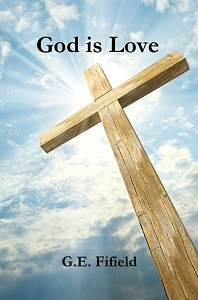
I have known him for a good many years, and known of him for a good many more years. My first introduction to his name was many years ago when a General Conference of Seventh Day Adventists was being held in this country, and we, in London, were eagerly looking for the bulletins giving the report of the proceedings. My attention was specially arrested by a series of addresses on the Love of God given by George E. Fifield, giving such a new view of the length and breadth and depth and height of the love of God that they were greatly blessed to me. And when later these addresses were published in book form under the title, “God Is Love,” I was very glad to get a copy to introduce to others. From that time Elder Fifield held a warm place in my heart.
HIS MESSAGE: Those of you who have listened to his preaching regularly know that this was his great theme; his favorite topics were the Love of God and the River of Life, the one growing out of the other,—the inexhaustible fountain of the love of God flowing out continually in streams of life and blessing to the world so that whosoever will may partake freely. And the constant dwelling upon this great theme so enlarged his own nature that his chief characteristic was his big loving heart, with the keen sensibility that always goes with that.
I am sure that many of you have heard Brother Fifield say more than once in many different ways, that every time we open our hearts to take in a new friend we are opening the door to the possibility of pain and suffering, but that the privilege of loving and the enlargement and enrichment of life that come through it, far outweigh the grief that it may occasion.
HOW HE GREW: That which chiefly distinguished Elder Fifield’s preaching, even from the earlier years, was his deep insight into spiritual truth, and his ability to present these deep things so simply and vividly that every one could grasp them. He had a large measure of that anointing which teacheth all things, and could and did say with Paul: “The Gospel which I preach is not of man for I neither received it of man neither was I taught it by man, but by revelation of Jesus Christ.”
And that was what made him so tenacious of the truth that he had seen, and laid such necessity upon him to preach it. That was why he could not modify or change his message. He was like Peter, who when threatened with death if he continued to preach in the name of Jesus said: “We can not but speak the things that we have seen and heard.” It is not a matter of choice with us, we must preach and take the consequences. Elder Fifield’s whole life was an effort to proclaim to others the things that he had seen and heard, and the message that he believed God had given him to preach, no matter what it cost.
And it did cost much; it cost him separation from brethren whom he loved and with whom he had long labored, and stepping out by faith into an entirely different sphere, with no visible means of support, but trusting in God who he believed had given his message to enable him to preach it. And this experience greatly strengthened his faith, and deepened his trust in God by proving His faithfulness, and gave him a firmer grasp of the promises of God, which made him a greater blessing to others.
In the meantime, doors of service opened wide to him, the truth he preached was gladly received by others, and his ministry was greatly blessed, so that he could say: “The things that have happened to me have fallen out for the furtherance of the Gospel.” Many of you know what his ministry here during these last few years has been, even when he was more or less incapacitated by illness.
There is one phase of that ministry that I think we are, perhaps, inclined to lose sight of or not take sufficiently into account. I mean the large number of Sanitarium patients and guests who attended those services in the chapel, some times over a period of weeks or months. Sometimes a large part of the congregation is composed of strangers, and I know from talking with them that many of them realized that they were specially privileged in listening to such preaching. I am glad that in this way, in these closing years of his ministry, he has been able to make his influence felt in all parts of the United States. He could not go out into all the land to preach, but people from all over the land have come in to hear him preach, and he has been able to touch their lives in a way that has been a blessing and help to many.
As I watched him that last Sabbath pouring out his soul with so much animation, the thought crossed my mind, knowing how ill he really was, I wonder how long he will be able to keep this up. He might have spared himself, he might have lengthened his life by refraining from preaching, but he felt that the object of his life would be gone when his preaching was done. He worked according to the principle of our Lord: “He that saveth his life shall lose it, but he that loseth his life for My sake shall keep it unto life eternal.”
I feel that we have great cause of thanksgiving today; we can give thanks for the victorious life of this triumphant servant of God; we can give thanks that for a season we were blessed by his ministry; and especially today we can give thanks that he now rests from his labors, with his trials and griefs and sufferings and sorrow all behind him, and nothing but eternal joy and glory awaiting him.
“Blessed are the dead that die in the Lord; yea, saith the Spirit, for they rest from their labors.”
One of the great trials of his late years had been the almost utter inability to sleep and to secure adequate rest. Now he has entered into rest. “No sleep so beautiful and calm, so free from trace of pain.” And who would awaken him if they could? I feel sure that his nearest and dearest would rather say; “Sleep on, Beloved, sleep and take thy rest.”
And now we can number him with the glorious company for whom we give thanks and praise to God when we sing:
“For all the saints who from their labors rest,
Who thee by faith before the world confessed,
Thy name, O Jesus, be for ever blest.
Thou wast their Rock, their Fortress and their Might,
Thou, Lord, their Captain, in the well-fought fight,
Thou in the darkness drear their one true light.”
“As the Stars”
The following sermon was preached by Pastor Fifield on the last Sabbath of his life, July 24, 1926; and is printed in response to the request of his friends, many of whom desire to possess a copy.
Scripture Reading: Isaiah, 40th Chapter, omitting verses 16 to 25.
Text: Daniel 12: 3—“And they that be wise shall shine as the brightness of the firmament; and they that turn many to righteousness as the stars for ever and ever.”
God, in seeking to communicate to us as human beings, could reasonably do no other than to speak to us in our human languages; and our human languages were born of our human experiences. Primarily, in point of time at least, we are physical beings, and our early experiences are physical, and have to do with physical things; and so it comes to pass that the words of our human languages are physical words; ninety per cent of them, almost all of them primarily, have to do with physical experiences and with physical things.
And so, as we have so often seen, when God, who is Spirit, seeks to speak to us in these physical languages of spiritual things He has to use physical things as images of spiritual things; and as we have seen in our studies here for years, God has thus used almost every conceivable physical thing on this earth. It would puzzle you to think of one He has not so used. Trees, rocks, vines, weeds, soil, clouds, rain, water, fountains, rivers, seas, food, drink, clothing, air, life, death, sickness, health, blood, breath, hands, feet,—all these, and countless others, are physical things God has used to teach us spiritual lessons. Many of these He has used so frequently in a spiritual sense that the word itself has come to have a spiritual meaning. The language itself, originally physical, as were the people who used it, has come to be in part, at least, spiritual, as have the people who use it. If some truly spiritual philologist would write a book on the transformation and spiritualization of the languages under the influence of spiritual religion, it would be a book of the greatest interest to all Christian students.
But God does not confine Himself to the physical things on this earth. He transcends the earth, and uses the sun, moon and stars in the heavens. The sun in its power to light and warm the earth, holding the worlds in the power of its mighty attraction, causing the fruits and seeds to grow, and filling the earth with food and gladness, has always spoken to men of God, and of the Sun of Righteousness with healing in His wings. The moon, too, is often used in the Word as a symbol of spiritual things; and what shall we say of the stars in their courses? From the earliest dawn of history until now, there is evidence that men have gazed on them, and felt the power and presence, and the eternal, unchanging reality of God. The wise men of the East who worshipped the infant Jesus, are not, by any means, the only ones the stars in their courses have led to worship God.
Go out of doors on a starry night, and contemplate the stars until you feel their mystic power to lift your own heavy-laden heart above the world and its petty perplexing cares into the realm of the supernally grand and divinely permanent, peaceful and unchanging. “The undevout astronomer is mad.” Skepticism and frivolous unbelief cannot hold up its head in the presence of these grand and silent messengers of God. I remember when I was in an observatory at Oakland, California, with a company of friends. The astronomer in charge said, “I like to show you around for you are serious and earnest.” He opened a door on the other side of which was a motto: “This is no place for frivolity, you are in the presence of God.” He said, “When foolish, frivolous people come in I show them that motto. The other day such a company was here and when I had showed them Vega, one of the most beautiful stars, a young man said, ‘Well that looks like a ham sandwich, now what more have you to show us?’ I said to him, ‘Nothing, until you come in a more serious frame of mind’.”
More than all other of His created works the stars have spoken to us of the greatness of God, and the splendor, and the unfailing permanence of His watchful care and constant power. Men once taught the geocentric theory of the universe. They thought this earth was the center. The sun and moon and stars revolved around it, and were made simply to give it light and heat, and to decorate the blue dome over head.
Under the guidance of Copernicus, Kepler and others, men rejected the geocentric theory and came to believe in the heliocentric theory of the universe. They taught that the sun, not the earth, was the center. Instead of the sun going around the earth, the earth revolved on its axis and went around the sun.
Men are now on the road to what might be called the theocentric theory of the universe. We know that the sun is only one of the stars, the center of this little system of worlds we call the solar system. But there are as many of these systems as there are stars or suns, countless millions of them. And while, as with us, each family of worlds revolves around its own holding central sun, all these millions of worlds, and systems of suns and worlds, and systems of systems of suns and worlds, are also in motion, revolving around some far-off center which astronomers have fixed in the constellation of Orion. And since God has created and numbered all these, and knoweth them all by name, and upholdeth them all by the word of his might, and for that He is strong in power not one of them falleth; what is more reasonable than to believe that the great center of centers is the Heaven of heavens, where God, in a special sense is, and where the angels have their home?
Only one thing, I think, prevents all people from seeing this. Many have ceased to think of God as a personal being, having in any sense a local habitation. But the Bible everywhere teaches this. No one can go beyond me in believing and in teaching the omnipresence and the immanence of God; but according to the Bible, God is omnipresent and immanent by His Spirit. “God is in Heaven and thou upon earth, therefore let thy words be few.” But “Whither shall I go from thy Spirit, or whither shall I flee from thy presence?”
At least this is true: the stars, more than any other created thing, speak to us of the vastness and eternity of God and the things of God. Even our sun, the center of this little system, is ninety-three million miles away. Light travels one hundred and eighty-six thousand miles a second, yet it takes eight minutes for light to come from the sun to us. Other stars or suns whose distance has been measured are so far that it takes hundreds and even thousands of years, for their light to reach us. Others, millions of them, are farther away than we can measure—so far away that it takes hundreds of thousands of years for their light to reach us.
And yet, in the mighty abysses of unfathomed space, they shine steadily on through God’s eternity, steadily exerting their attraction to hold their worlds in their courses. Oh, the wonder and greatness and splendor eternal of the unchanging God! When we come back to the things of earth, and to the cares and trials and petty disappointments of our little lives, with their hopes and fears, joys and sorrows, how small they seem. God is infinite here as in the great things; He is equally great in the infinite and infinitesimal. How different the lesson from what many get from the stars is this fortieth chapter of Isaiah.
God has often used the stars to give us hope in despair, and courage in discouragement. We have an instance of this in Genesis 13, 14 and 15: 5. Picture it: Abraham had just had a battle with five kings and had overcome them, but had refused to take any of the enrichment of their substance. Yet he knew he had made them his enemies and that they would not forget. After the victory there came a time of discouragement when he was thinking things over. He was a lonely, childless man and to be childless was the greatest affliction. “Here I am, growing old, with many enemies, and no one to continue my name after me,—no one to fight for, no one to make life worth while.” Have we not all felt so at times? Then God spoke to Abraham: “Go out at night. Tell the stars, if thou art able to number them. So shall thy seed be.”
A few hundred years later we have the case of Moses in Exodus 32: 13, and chapter 33. He had come down from the mountain with the Law, having had a wonderful experience in the presence of God, and he found the people naked, dancing around a golden calf, in one of those unspeakable orgies of Apis worship they had learned in Egypt. It seemed utterly useless and not worth while to bring to such God’s pure law. What is all his life work worth in leading them up from Egypt and in bringing the law to them? God will destroy them in their sins. Then he threw down the tables of the law and broke them. But he thought of this promise to Abraham, and of its fulfillment so far; and he besought God to spare His people. “Spare Thy people, Oh, Lord; or if not, blot me out of Thy Book.” I will not accept Thy blessing in the place of them. And what did this all lead to? The forty days with God, and the greater revelation of His glory in the 33rd chapter.
Coming back directly to the text, the scripture is the eternal Word of God, eternally applicable in principle at all times, but often it has special application at special times. It is so with this text. Read verses 1 and 2, also verse 4. This has special application now at this closing of the age, this time of transition. And why? Because the conflict of the ages is coming to the climax here. Satan is to be working with all power, and signs and lying wonders. And yet the Gospel of Christ is to shine away the darkness of the kingdom of darkness until the earth will be lightened with His glory. But many times, as often in the past, it will seem as if the error had triumphed. Christ Himself was a martyr, and they that will live godly in Christ Jesus, shall suffer persecution. Often the child of God seems to have a thankless task. The more spiritual his message, the fewer those who hear; the more deaf ears. Christ realized this.
All the heroes of the faith were men and women of whom the world was not worthy. It persecuted them, and rewarded their persecutors. Surely, it seemed to them many times, their sun was to set in darkness. Their lives were to go out without earthly recognition or reward. Not in scripture times only, but in recent years. Read the history of Judson and of Cary, and of modern missions. It will seem so in the coming conflict near the end.
Is there anything more eternal, more permanent and more abidingly beautiful than the stars? The glory of the Christian is not confined to this life; his is the eternal life, and his glory is spiritual and eternal. “He shall shine as the stars forever and ever.” And this, like all other scriptures, is interpreted from the physical to the spiritual. The stars are physical objects, with a physical glory; but God is spiritual and looks not on the outward appearance but on the heart. God’s glory is not the physical glory of clouds and rainbows about the throne; at least, not this only. (Exodus 33). So of the glory of the Christian character. “The beauty of the Lord our God shall be upon us”—Christ’s beauty. The spiritual beauty of the stars, and their constant, abiding nature is taken to show the spiritual and unchanging glory of the redeemed.
And this abiding glory as of the stars will not come to us in any arbitrary, unnatural way. When Rome canonizes her saints, she does it physically, externally, noisily, and usually some five hundred years after they are dead. Perhaps she martyred them when they died. But God canonizes His saints silently, spiritually, internally, when no one is looking; when they, themselves, do not understand what is being done to them. Mostly they see the shadows, and do not see “the bright light in the clouds.” That comes later. (Psalm 90: 17).
Christ is the Light of the world, the Sun of Righteousness with healing in His wings; but He said, “Ye are the light of the world.” We are the stars, the lesser lights. How many men, lost at night on the trackless ocean, or on the pathless desert, or in the woods, have been guided safely home by the stars. It is thus in life’s deserts, and on our storm-tossed ocean, that God would use us in guiding men home to Him, and to the Father’s house. And as we do this, we shall shine to them as the stars.
Can you not imagine a man lost and wandering, starving and perishing with thirst, on some desert, hope almost gone, and he is ready to lie down and die. Then he catches a glimpse of some familiar star, and by this is led home to safety and food and water and comfort and affection. Would not that be the star of stars to him ever after? Would it not mean to him more in its shining than all the others? Even so as we are wise in the things of God, and turn men to righteousness, to them, we shall shine as the stars and forever.
I remember hearing a story illustrating the song we are to sing in closing, “Let the Lower Lights Be Burning.” You recall when electric lighting first came into use, they had the powerful arc lights set on high towers. Only a few were needed to light a whole city. Still they kept the little gas lights burning. A man trying to find a place in a large city wondered at this but soon discovered these “Lower lights” were needed to find the numbers on the houses. “Let your light so shine that others may see your good works and glorify your Father who is in heaven.”
There is a story of two Irish women. One, Annie, had a son killed in the war. Mary, her friend, came to visit her and asked if she knew where Henry was. Annie said, “I know he is in God’s hands, but more important for you and me it is to know where God is, to find God for ourselves.” So they knelt down and Annie poured out her heart to God and as she prayed she put her hand on the head of the doubting Mary. Mary sprang up saying, “He has done it. I felt God’s hand on me. It thrilled me from head to foot. It felt like your hand, Annie, but I know it was God’s.” Annie said, “Yes, Mary, it was God’s hand and it was my hand.” God uses any hand he can control to point the way and to guide men to Him.
One last illustration in closing, which shows the other side of this. Oh, that men would yield themselves to God’s guidance! About three years ago a large ship was coming down from Skagaway, Alaska, with 475 miners and a crew of about 50 on board. Overtaken in a storm the ship sent out the S. O. S. call, as men send out this call for help in the storms of life when their boat is on the rocks. In answer to the call many boats came, small and large, but the Captain of the large steamer said, “We are all safe and comfortable here and we do not know how seriously the ship is injured, just stand off and wait a while and as the tide rises perhaps we will come off the rocks.” So the boats waited, but the storm grew worse and worse until one by one the smaller and then the larger of the boats that had come to help were compelled to seek their own safety. Then the large ship began to break up and with terror sent out another S.O.S. call, but the ships that had come to help could not reach her, and the last wireless message came saying, “We have only time to say good bye.” When the storm subsided so the boats could reach the large ship all that was visible of the steamer and the more than five hundred men and women she had carried was one spar still standing above the waves. They all might have been saved if they had answered the first call when help was offered them, but they said, “We are comfortable now; wait a while.” “Today is the accepted time, today, if ye will hear His voice harden not your hearts.” We know not what the storms of tomorrow may be, tomorrow is not ours, only today.
George E. Fifield