The Recovery of George E. Fifield: A Discovery and Its Significance
About This Archive
The materials housed on this website represent the most complete collection of the writings and sermons of George Edward Fifield (1859–1926) ever assembled—most of them previously unknown, uncatalogued, and inaccessible to scholars and readers until their recovery in 2025 and 2026 by Patrick J. Irving of Father of Love Fellowship.
This is not simply a digital library. It is the record of a recovery—the story of how a significant theological voice, lost for nearly a century, was found again.
Who Was George E. Fifield?
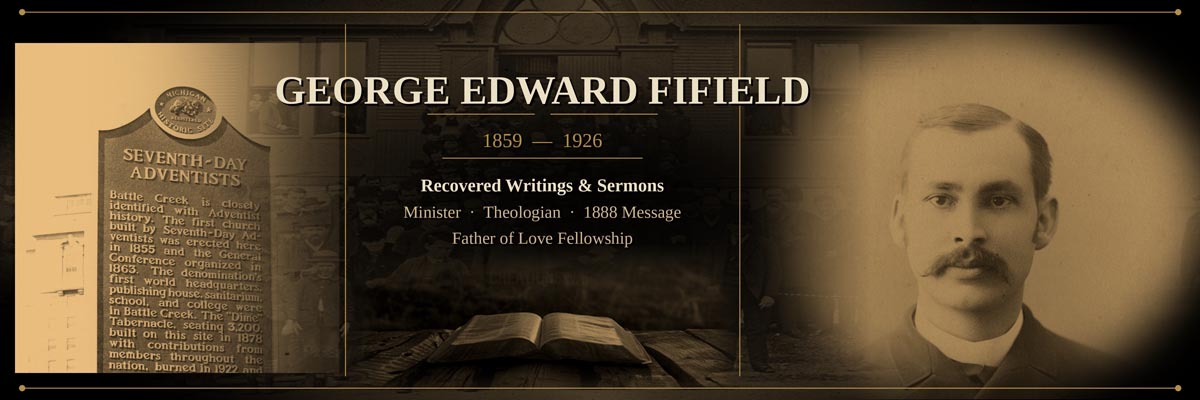
George Edward Fifield was a Seventh-day Adventist minister, theologian, and religious liberty advocate whose career placed him at the intersection of some of the most important theological developments in American Protestant history. Educated at Battle Creek College and ordained as an SDA minister, he served congregations across New England, became Secretary of the New England Religious Liberty Association, and emerged as one of the most gifted preachers of his generation.
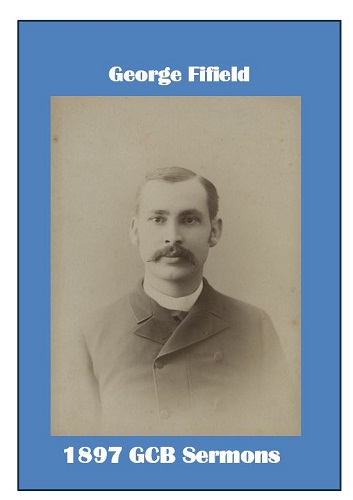
His significance crystallized at the 1897 General Conference of Seventh-day Adventists, where he delivered a series of sermons developing the theological themes that had burst into prominence at the 1888 Minneapolis General Conference—the revival of righteousness by faith, the character of God, and the meaning of the New Covenant. His book God Is Love, published that same year, distilled these themes into a sustained theological argument that God’s character is defined entirely and exclusively by love—with profound implications for how we understand the atonement, the law of God, human freedom, and the nature of salvation itself.
In the early twentieth century Fifield affiliated with the Seventh Day Baptist denomination, serving congregations in Chicago and Battle Creek, Michigan, until his death in 1926. During those years he continued to preach and publish with remarkable theological consistency, developing the vision he had embraced at the height of the 1888 revival into one of the most sustained and coherent expressions of the nonviolent God tradition in American Protestant history.
He died largely unknown outside the communities he had served. His published works, outside of God is Love, went out of print. His sermon manuscripts were packed away. And for nearly a century, one of the most theologically significant voices connected to the 1888 message was effectively lost and forgotten.
The 1888 Message: Why Fifield Matters
To understand why the recovery of Fifield’s writings is significant, it helps to understand the theological tradition to which he belongs.
The 1888 Minneapolis General Conference of Seventh-day Adventists is widely regarded by Adventist historians as one of the most theologically charged moments in the denomination’s history. At that conference, ministers Alonzo T. Jones and Ellet J. Waggoner presented what Ellen White would describe as a “most precious message” God had sent to the church—a renewed emphasis on righteousness by faith, on the grace and love of God, and on the character of a Father who saves not by legal transaction but by the transforming power of His indwelling love.
The reception of that message within official Adventism was deeply ambivalent. While Ellen White championed it, significant institutional resistance prevented its full theological implications from ever being formally embraced by the denomination. Jones and Waggoner themselves eventually left the church, and the theological vision they represented was marginalized within official Adventism for decades. The 1888 message became, in many accounts, a story of promise unfulfilled—a theological revival that flickered brightly and was then suppressed by hardened hearts.
But that account, however accurate it is as a description of the institutional story, misses something important. The 1888 message did not simply disappear when its institutional moment passed. It was carried forward—by a minister who had genuinely received it, who refused to let it die, and who spent the rest of his life working out its implications with pastoral depth and theological consistency.
George E. Fifield was this minister, and the recovery of his literary corpus changes the 1888 story in ways that matter deeply.
What the Recovery Reveals: A New Argument for an Old Debate
For generations, a shadow has hung over the 1888 tradition within Adventism. The shadow is this: both Jones and Waggoner, the message’s primary voices, ended their theological careers in places difficult to reconcile with their earlier work. Jones drifted into theological confusion. Waggoner moved in directions that seemed to leave authentic Adventism behind. This trajectory has given ammunition to those who argue, implicitly or explicitly, that following the 1888 message consistently leads outside the bounds of genuine Adventist theology.
The recovery of Fifield’s writings—and most decisively, the recovery of his personal Sabbath Scrapbook—answers that argument with primary source evidence.
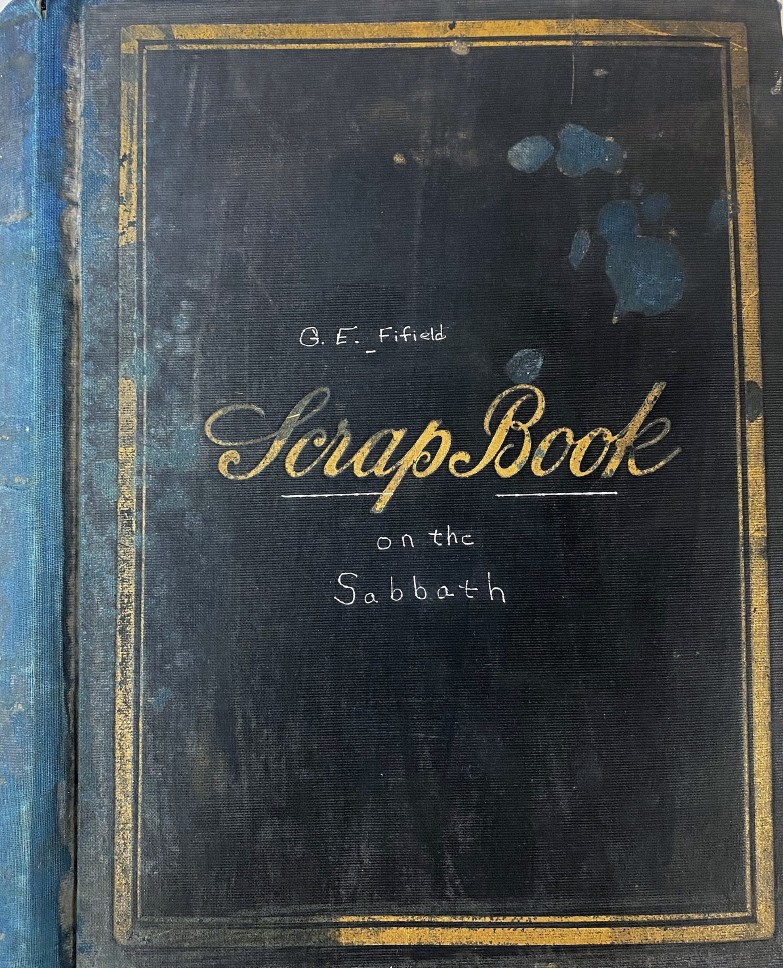
The Sabbath Scrapbook is a large, handwritten and annotated working research file bearing Fifield’s name on the cover in his own hand, assembled across his ministry and held at the Seventh Day Baptist Historical Library and Archives in Janesville, Wisconsin. Its contents establish beyond reasonable doubt that Fifield retained the core Adventist prophetic framework throughout his life and ministry—including the 2,300 day prophecy, the 1844 platform, the three angels’ messages of Revelation 14, and the eschatological significance of the Sabbath as the seal of the living God.
He never abandoned 1844. He never set aside the three angels’ messages. He never let go of the Adventist prophetic vision that frames the closing conflict of history in terms of the choice between the worship of God and the worship of the beast.
What Fifield carried out of official Adventism was not a departure from its theology. It was that theology—the best and deepest of it—freed from the institutional constraints that had prevented its full expression. His departure was not apostasy. It was, in his own understanding, a continuation of the very message the institutional church had failed to embrace. He went where he could preach what Minneapolis had promised without the resistance that had frustrated it within official structures.
This means that when we read Fifield’s sermons and pamphlets—his sustained treatments of the atonement, the covenants, righteousness by faith, the character of God, and the Sabbath as the sign of the soul’s rest in divine love—we are not reading the theology of someone who left Adventism and found something better. We are reading the theology of someone who carried Adventism’s theological inheritance forward into its most coherent expression.
That is a historically significant argument. And it is now documentable with primary sources that did not exist in any accessible form before this recovery.
The Discovery: What Was Found and How
The recovery documented on this website proceeded in several stages.
It began with a single book—The Water of Life, published posthumously by Fifield’s widow Alice White Fifield in approximately 1927 and surviving in only the rarest copies. Its discovery in 2025 led to more investigation into what other Fifield publications, if any, might be out there. A modern reprint edition was transcribed by Patrick Irving and published through Father of Love Fellowship in 2026.
Correspondence with the Center for Adventist Research at Andrews University yielded letters from Alice W. Fifield to Adventist dissenter Edward S. Ballenger in the late 1930s—letters that confirmed a substantial collection of George’s sermon manuscripts had been preserved and were being actively shared with theological researchers. A tribute letter from United States Congressman August E. Johansen, written on House of Representatives letterhead in December 1957, described “this splendid collection of sermons” as being preserved through the diligent efforts of Alice W. Fifield and Dr. B. F. Johanson of Battle Creek. The question was where that collection had gone.
The answer was found on a Tuesday morning in June 2026 at the Seventh Day Baptist Historical Library and Archives in Janesville, Wisconsin. While examining files relating to Fifield, a cataloguer’s note referencing that very collection of sermon manuscripts was noticed. After inquiry, the archivists searched and located—hidden away in basement storage, uncatalogued and unknown to current staff—a binder containing more than 150 typed sermon manuscripts with a topical index, organized by Alice Fifield herself. The sermon collection is remarkable testimony that the theological principles of the 1888 message continued to shape Fifield's ministry long after his departure from Adventism. Its subjects range across the full sweep of those convictions: righteousness by faith, the atonement, the covenants, the character of God, religious liberty, and more—preserved in a breadth and depth that no modern scholar has previously had access to. Tucked into the back of the binder were four published pamphlets entirely unknown to the bibliographic record. Combined with five additional Fifield pamphlets already held in the SDB Archives' catalogued collection, the total number of recovered Fifield pamphlets now stands at nine.
The sermon index further listed, under “Books,” a title previously unknown to modern scholarship: Law of Spiritual Transformation, apparently published posthumously by Alice for her husband in 1929. This book does not appear on WorldCat. It is not held at the James White Library at Andrews University or any Adventist institution. It was not held or recognized by the SDB Archives at Janesville. After considerable searching, a single surviving copy was located and acquired. It appears to be the only copy currently known to exist.
Also surveyed during that visit was Fifield’s personal Sabbath Scrapbook—the intimate working research file described above, whose contents establish the theological continuity of his career.
Why This Matters Now
The recovery of Fifield’s writings arrives at a moment when the questions he spent his life answering are very much alive. The conversation about the character of God—whether the divine nature is fundamentally noncoercive, whether the atonement is best understood as a revelation of love rather than the satisfaction of wrath, whether salvation is genuine internal transformation rather than legal transaction—is one of the most active theological conversations in contemporary Christianity, engaging scholars and thoughtful believers across multiple traditions.
Fifield was addressing these questions with remarkable sophistication a century ago. His argument that God “would not use external compulsion of force” because He knew the worthlessness of all forced obedience, that the law of God is best understood as an expression of His character rather than arbitrary decree, that the New Covenant means Christ writing His law on the heart so that obedience to all the laws of God becomes the natural expression of love rather than legal compulsion—these are not antiquarian curiosities. They are living theological arguments whose recovery at this moment is not without significance.
For Adventist readers in particular, Fifield’s recovery offers something rare and valuable—a primary source witness to the 1888 message whose career demonstrates that righteousness by faith, the nonviolent God, the truth about the covenants, and the Adventist prophetic framework are not in tension but in profound continuity. He preached them from the same pulpit as expressions of a single coherent theological vision, and the recovery of his voice is an invitation to receive that vision in its fullness.
The 1888 message has too often been told as a story with two protagonists—Jones and Waggoner—and a tragic ending. George Edward Fifield is the third protagonist the story has been missing. And his voice, recovered after nearly a century of silence, is another opportunity for the Church to repent and receive the full expression of the message brought to God’s people in 1888.
About This Project
The materials on this website have been recovered through the research of Patrick J. Irving, author of Behold the Lamb: A Treatise on the Character of God. Transcriptions and editorial additions have been carefully and thoughtfully prepared by Patrick Irving, Adrian Ebens, Ben Kramlich, Danutasn Brown, Daniel Bernhardt, Max McClelland, and Adam Pearce, in collaboration with Father of Love Fellowship.
Inquiries may be directed to Father of Love Fellowship.
“Who would not love and worship such a Father God as revealed in and by Christ? Come one and all and let us give our lives to Him more completely, now and forevermore.”—George E. Fifield, Christian Citizenship No. 1: The Law of Liberty
Written June, 2026