
 Scripture Readings: Matthew 1: 18 to 25; Luke 2: 7 to 14.
Text: Matthew 2: 2—“Where is He that is born King of the Jews? For we have seen His star in the east, and are come to worship Him.”
We all love to think of that night so long ago, when, on the darkness of earth, the light of heaven shone, manifesting the wonderful nearness of the Divine Presence. God had been long preparing for the birth of His Son. The hearts of His people had been filled with longing, their gaze focused upon the Coming One. Through a thousand years the world had been preparing religiously and politically: Religiously, in that men had lost faith in all the gods, and human hearts were hungry for some new manifestation of the Divine Spirit; Politically, in that all the world, as never before, had become unified under one government, one language, and one law, so Christ could be born, not merely to some petty tribe or nation, but to the world, and His message go, as He commanded it should, to all the world.
So, in the fulness of time, foretold by all the prophets; foresung by all the inspired poets all down the centuries, foreshadowed by all the types and ceremonies, Christ was born in Bethlehem of Judea. Angels from Heaven came to announce the glad news: “And suddenly there was with the angel a multitude of the heavenly host praising God, and saying, Glory to God in the highest, and on earth peace, good will toward men.” Luke 2: 13, 14.
Before I proceed to my theme I want to pause a moment to draw a needed lesson from this record of the Annunciation. We are wont to think of this and of other Divine manifestations as showing Heaven especially near at that particular time. This is never so. Jesus Christ is the same yesterday, today and forever. With God, too, there is no variableness, neither shadow of turning. “I am the Lord, I change not.” God does not draw near at times and then recede into the dim distance. It is our unbelief that makes Him seem far away. “He is never far from any one of us; He is nigh thee in thine heart, and thy mouth, if thou wilt only believe.”
In various ways and at various times He manifests His nearness for our faith to grasp the fact, and so believe He is always near. The manna was not simply to show that God fed Israel in the wilderness, but to show that He feeds us all the time. This Angelic anthem of praise was not to show that Heaven had drawn especially near at that moment, but to show that Heaven is always so near that, as Jesus said, there is joy in Heaven among the angels at the Coming of Christ into one new-born soul. The whole incarnate Life of Christ was not simply for us to believe He was on the earth then where men could see Him; but for us to believe He is now, when we cannot see Him,—and here to do by the Spirit, in our flesh now, what was done by the Spirit in His flesh then. This is the Everlasting Gospel, the good news of the eternal, omnipresent nearness of the Divine, with all His loving, transforming, and Glorifying power. To believe and receive this is to be saved.
Now to the text: “Where is He that is born King of the Jews?” The question was asked by certain wise men from the East, who had seen His Star, and come to worship Him. Astronomy had its origin in the East. Those men were interested in stars, and were watching them and studying them from night to night. An angel, a messenger of the Holy Spirit, took the form of a star that moved mysteriously, as these men had never seen a star move before, and seemed to beckon them to follow it. Do you get this? Took the form of what they were interested in, to lead them to Christ and cause them to worship, and to lay their treasures at His feet. O! that all preachers and religious teachers would learn that lesson. And they came as a symbol and revelation of how all the wise men of the world will yet worship and lay their treasures at the feet of the world’s Saviour. The Prophet John saw this day when he wrote, “The kingdoms of this world are become the kingdoms of our Lord, and of His Christ; and He shall reign forever and ever.” Revelation 11: 15.
Paul said, “He is not a Jew who is one outwardly.” “If ye be Christ’s ye are Abraham’s seed.” Christ was born not merely nationally to the physical Jews, but to the whole world as King of Spirits, to all who will yield their spirits to Him.
It was Herod who heard this question: “Where is He that is born King of the Jews?” And he was instantly interested and disturbed; for Herod was king, and, as is the wont of kings, he wanted no competition in the king business. There is never room for two thrones in one dominion. Jesus said, “No man can serve two masters.”
Herod made diligent inquiry as to where Jesus was to be born; and, learning it was to be at Bethlehem, he caused all the children of Bethlehem two years and under to be killed. Thus determined was he to get rid, in the very beginning, of any possible dispute to his sovereignty. Blood flowed because a baby was born into the world with the title of king.
And what happened in the beginning of Jesus’ life went on happening unto the end. The Herods of Palestine were always in a state of perturbation, and were constantly plotting to kill Him. The kings of political, social and ecclesiastical life from the start distrusted Him. They thought He jeopardized the security of their thrones. And yet, the Jewish people had been taught to look for a Messiah who was a political deliverer and they were ready to receive Him as such. On one occasion they tried to take Him by force and make Him king; and He hid himself from them, and went away. He said, “My kingdom is not of this world; if it were, then would my servants fight.” He came as King of Love, to establish the kingdom of love in the hearts of men. He was to rule not outwardly by force, but inwardly by love.
And yet, He ever insisted that He was King. If He had been content to play the part of a gentle and sympathetic physician only, making war on the empire of pain, the whole people would have chanted His praise. But He claimed to be King. Had He been content to be the expounder of beautiful theories, the interpreter of glowing ideals, the people would have listened to Him with pleasure, and He would have gone to His grave with honor. But He claimed to be King. He was always speaking and acting in a way that implied regal authority. People said, “Never man spake like this man.” They did not like to hear a peasant speak as if His word was final. The Rabbis quoted only from other authorities. He expected of them more implicit obedience than had even been demanded by Moses and Solomon. He did not hesitate to ask men to lay down their lives for His sake. He said, “Ye are my friends if you do whatsoever I command you.” This is the fashion of kings.
And yet, Jesus did not look like a king. He had none of the pomp and glory of kings. He wore no crown; He wielded no scepter; His robe was not purple. He did not ride in a chariot or on a horse. No retinue of armed men was in His train. He did not shake the earth with His tread. To some people His claim to kingship seemed preposterous and blasphemous. He claimed to be monarch in the realm of the spirit. One day He sketched a picture of the Judgment, and placed Himself on the throne. He told parables which implied that the final destinies of all men were in His hands. To the thief beside Him on the Cross he said, “Verily, I say to thee this day, with me in the Paradise thou shalt be.” Before He was crucified He allowed the people to gather around Him and chant the words of the Hebrew prophet, “Blessed is the King that cometh in the name of the Lord.” They called Him King and He did not rebuke them. On the contrary, He said, “If these should hold their peace the very stones would cry out.”
It was this assertion of His Kingship that caused the storm to break at last.
The people brought Him before Pilate and accused Him of claiming to be king. Pilate asked Him, “Art thou a King?” Even to save His life Jesus would not deny His Kingship. He said to Pilate, “Thou sayest it. To this end was I born. For this purpose came I into the world. But my kingdom is not of this world; if it were, my servants fight.” Notice this text, in the world, but not of the world. Pilate was impressed and would have delivered Him. Pilate said to the people, “I find no fault in this man.” But the mob threatened to report Him to Caesar, and roared, “If thou let this man go, thou art not Caesar’s friend.” And so Christ was crucified, the people saying, “We will not have this man to rule over us.” And above His head as He hung on the Cross was this inscription in Hebrew, Greek and Latin: “Jesus of Nazareth, the King of the Jews.”
This tragedy narrated in the Gospels is the story of a tragedy continued unto the present hour. Jesus still claims to be King, but now, as of old, Herod is enraged against Him, and the kings of this earth are gathered together against the Lord, and against His Anointed. The multitudes are still shouting, “We will not have this man to rule over us.”
As a genial and gentle teacher, Jesus has many admirers. His teachings are extolled by all who are capable of appreciating high and noble thought. The whole world is glad to praise Him as an ethical guide without a peer. The moral precepts of the Sermon on the Mount are eulogized by men of many schools, and one of His rules has been called “Golden.” The multitude are eager to praise and honor Jesus as teacher, philosopher, poet, idealist and reformer, even lover of humanity; they hesitate only when they are asked to crown Him king, and yield to Him the obedience of their heart.
Yet here is the point where Jesus is most insistent. “Why call ye me Lord, Lord, and do not the things which I say?” Without obedience He promises no man salvation,—no man or nation of men. “Whosoever heareth these sayings of mine, and doeth them, I will liken him unto a wise man, which built his house upon a rock: And the rain descended, and the floods came, and the winds blew, and beat upon that house; and it fell not: for it was founded upon a rock. And every one that heareth these sayings of mine, and doeth them not, shall be likened unto a foolish man, which built his house upon the sand: And the rain descended, and the floods came, and the winds blew, and beat upon that house; and it fell; and great was the fall of it.” Matthew 7: 24-27.
It is not enough to call Jesus poet, philosopher, reformer and teacher, and to sing His praise as such. The whole world is doing this today; but every nation in the world is crucifying Him a million times over, because they will not crown Him King, and do the things that He says. And the nations are crucifying Him precisely for this reason that the individuals that compose these nations are crucifying Him, each in his own heart, saying, “We will not have this man to rule over us.”
“Unto US a child is born, unto US a son is given; and the government shall be upon His shoulder: And His name shall be called Wonderful, Counsellor, The mighty God, The everlasting Father, The Prince of Peace.” (Isaiah 9: 6.) When Christ is born into a human soul, He comes in as King. “The government shall be upon HIS shoulder.” Where is He that is born king of the Spirit? Where is He today in your life? Is He King of your spirit? Are you having such experiences with Him, in His Kingdom of Love, that you, spontaneously, out of a full heart, are saying, “Wonderful, Counsellor, The Mighty God, The Everlasting Father, and The Prince of Peace?” Are you? Are you enthroning Him as King in your heart, and yielding to Him the obedience of your soul? Or are you crucifying Him afresh in your soul, saying, “I will not have this man to rule over me”?
Christmas is here. On this day we naturally think of Jesus. Which Jesus are you going to think about? The Jesus of art? He is beautiful, even though imaginary. Multitudes have looked on His picture for centuries, and are not yet wearied. Shall it be the Jesus of song? He is perhaps still more beautiful. “How sweet the Name of Jesus sounds in a believer’s ear.” He has been the theme of thousands of songs, oratorios, cantatas and carols, and all are ready every year to join in singing the Christmas songs. The Jesus of the biblical narrative is also entertaining. We never grow weary of hearing about the babe born in
Bethlehem’s manger. But Jesus, the Son of God, is King, and was born to be King. And while we sing these songs, we are either Crowning Him King, and enthroning Him King in our hearts, or else, our perverse hearts are crucifying Him, that self may be enthroned, saying to Him, “We will not have this man to rule over us.”
Multitudes who have called Him Lord and have sung His praise will come in that day, and say, “Lord, Lord, have we not prophesied in Thy name? and in Thy name have cast out devils? and in Thy name done many wonderful works?” And Jesus will say, “I never knew you.” The problem of our lives is to bring the Herod in us into subjection to Christ the King. Herod is of the earth, earthy. He lives solely for himself. Herod is averse to service and sacrifice; despises the way of the Cross. Herod is always consciously or unconsciously planning to crucify Jesus. He would kill Him because Jesus insists that if He comes into our hearts at all, He must remain there as King. So long, therefore, as we refuse Him full admission into our hearts, we are of those who are keeping the world in its present state of suffering, sorrow and sin, and delaying the setting up of His Kingdom.
“Behold, I stand at the door and knock; if any man hear my voice, and open the door, I will come in to him, and will sup with him, and he with me.”
Have you opened the door and let Him in?
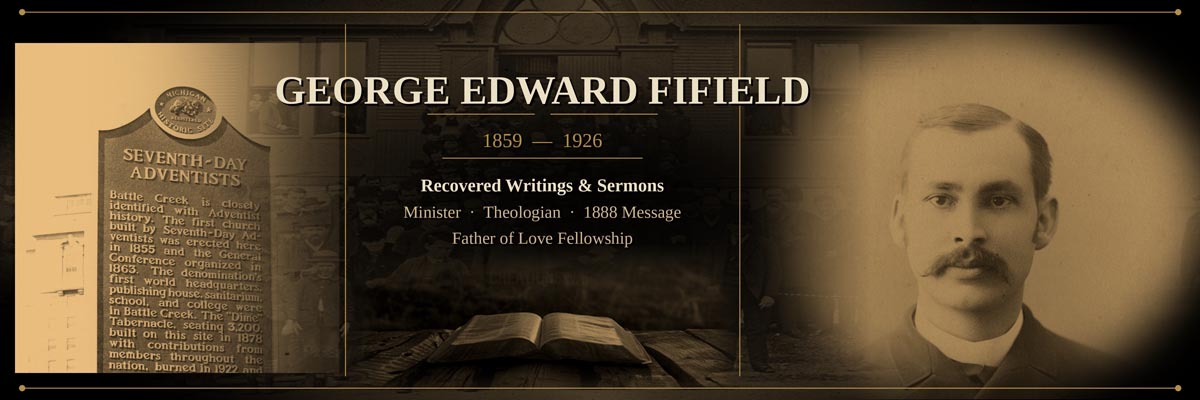
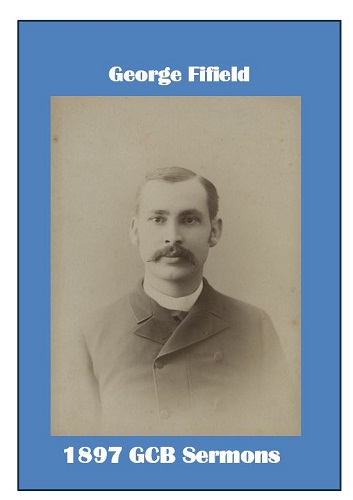
George E. Fifield