 PREFACE
It may seem unusual to begin a brochure with a preface; in this case, however, it seems necessary.
The plea for the worship of God, and against the worship of the “Beast” which the writer seeks here to make, is no I-am-more-righteous-than-thou message. These scriptures are not here to be used, as they have so often been used in the past, as a sort of theological mallet with which to hit others on the head.
The author believes that here is a great soul-searching spiritual message to enable all, himself included, so to test their worship as to discover if indeed it is such as to be well-pleasing to our Heavenly Father. The object of this writing is to warn people against deception, and to help them to a higher, purer, simpler, more comforting, and more soul satisfying worship.
The author does not willingly oppose himself to any other explorer in the field of truth; far less would he needlessly attack the positions of another. There is, doubtless, much truth in many of the so-called “new” theories of the “beast” and his “image.” Such a federation of nations as is taught may be formed, both in the revival of the “beast,” and in the formation of the “image.” That such federations shall be formed may be included in the prophecy of the “beast” and his “image.” But to limit the Bible teaching concerning the Beast and the Image to the prophecy of the formation of such federations, and to warning the people against them when, and as, they are formed, is a most fatal error. It leaves the seed and the root of evil in the ground, and contents itself by attacking the tree in its outward manifestation, only.
The call to the worship of God, and the warning against the worship of the beast, is a universal, and an age-lasting message, the most soul-searching, and spiritual in all the Bible. We will grant it a special application at some time in the future; but even that application is weakened, rather than strengthened by failing to see and to teach its universal application now.
“Ye shall know them by their fruits” is a divinely given test as applicable to doctrines and to methods of teaching as to institutions, and to men. It has seemed to the author that wherever the so called new teachings have been received, the people have ceased to feel the spiritual force of this message in its present application to their soul’s need; and have come to look upon it as merely a prophecy, and a warning for the future. In part because of this fact, and yet, primarily, to show that the message contains deeper, and more spiritual truths for us now than many have ever seen therein, this little pamphlet is written.
The author prays that Our Heavenly Father may bless these truths to the good of many others as He has already blessed them, and continues to bless them to the guidance, and nourishment of his own soul.
Yours for Truth and Righteousness.
G. E. Fifield.
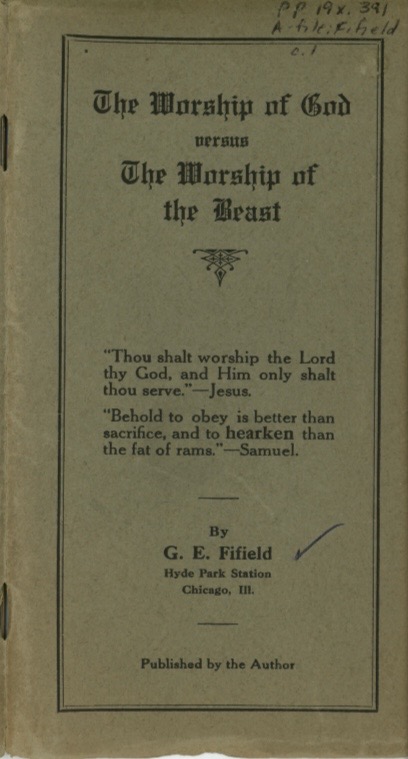
The Worship of God versus the Worship of the Beast
“And I saw another angel fly in the midst of heaven, having the everlasting gospel to preach unto them that dwell on the earth, and to every nation, and kindred, and tongue, and people, saying with a loud voice; Fear God, and give glory to him, . . . . and worship Him that made heaven and earth, and the sea, and the fountains of waters . . . . . .
And the third angel followed them, saying with a loud voice, “If any man worship the beast and his image, and receive his mark in his forehead, or in his hand, the same shall drink of the wrath of God which is poured out without mixture into the cup of His indignation.” (Rev. 14: 6-10.)
The preceding chapter presents this beast to view, and tells us that the dragon, “That old serpent which is the devil, and satan” gives him his power, and his seat, and great authority. All the world is presented as “wondering after the beast,” and “worshipping the beast,” and the “dragon which gave power unto the beast,” and saying, “Who is like unto the beast, and who is able to make war with him?”
Later in the chapter, another beast is brought to view; and we are told that this beast deceiveth them that dwell on the earth, and causes them to make an image to the preceding beast, and that it “causeth the earth, and them which dwell therein to worship the first beast.”
The fourteenth chapter follows this one, with its great world wide call to the worship of the true God, and its solemn warning against the worship of the beast, and his image.
There are many things spoken of in both of these chapters to which we can not even allude in this pamphlet. We call the reader’s attention simply to the one requirement, and the one warning in contrast;—the requirement to “worship God,” and the solemn warning against the “worship of the beast.”
In Washington there are men who are exceedingly expert in detecting counterfeit money. Only the best counterfeits reach Washington; the poorer ones are thrown out by the banks through which they pass. But the instant the eye of one of these experts rests on even the best counterfeit, he detects it for what it is, and throws it aside. And yet, he never studied a counterfeit bill, and would not dare to do so for fear of losing his marvelous power. He studied the true bill until every line and shade of it is photographed on his mind, and any bill that does not in every particular, come up to this perfect mental picture, he knows at once, is counterfeit. So we here, will first study the Worship of God until, knowing, and feeling truly what it is, we may better detect the counterfeit worship, the worship of the beast.
The Worship of God
The worship of God is not merely, or primarily, a sentiment, or an emotion. It is the soul’s absolute allegiance given spontaneously, and in perfect loyalty, to the Creator. God is worshipped truly by us, only when we give to Him the place in our lives which He created for Himself.
In the Tabernacle of the Israelites, and later in the Temple, there were two apartments, an outer, or “Holy Place,” and an inner, or “Most Holy Place.” In the Holy Place was the altar of incense where the sacred fire was kept constantly burning, the seven lamps supplied with the oil of the bruised olive, and also kept always burning; and the table of the bread of the Presence.
In the Most Holy Place was the Ark wherein were the tables of the law, and above which was the Mercy Seat overshadowed by the outstretched wings of the covering cherubim. Here was the visible shekinah of God’s glorious presence,—the representation of His throne on earth, as saith Isaiah, “God of Israel that dwellest between the cherubims.” “Howbeit the most High dwelleth not in temples made with hands,” merely “as saith the prophet” “Where is the house that ye build unto me, and where is the place of my rest?” (Isa. 66: 1 & Acts 7: 48, 49.)
Paul says, “Know ye not that ye are the temple of God, and that the Spirit of God dwelleth in you?” And again he says “Ye are God’s building.” (1st Cor. 3: 16 & verse 9.) Again “For ye are a living divine Sanctuary, as God hath said, I will dwell in them, and walk in them.” (Modern English translation 2nd Cor. 6: 16.) There are in this living sanctuary, the Intellect, and the Heart,—two apartments, the outer, and the inner.
God wants to illuminate our minds by his seven-fold Holy Spirit, and to feed them with the bread of heaven; but in our hearts he wishes to write his law, and abide above it there by His glorious, and glorifying presence, enthroning Himself there to rule our lives.
It is here from His throne in the heart, that God makes His will known personally to the individual; and obedience is the highest worship. We can worship God only when we give Him this place He has made for Himself, in our lives, and yield to Him an unquestioning, and an ungrudging allegiance. The heart that is yielded to God is a “fortress He holds in an enemy’s country” and He would be the supreme and only recognized authority there.
A Homely Illustration
If the reader will pardon the use of a very homely illustration, God made a dog for a man, exactly as he made a man for Himself. God made a place in a dog’s heart, for a man. Man is God to the dog,—the highest dog-thought he can think. The dog rises to his highest possible dog-estate only when he has enshrined in his heart some man whom he can love and respect, as master. The dog that loses his master immediately begins to go downward, and soon becomes a cringing cur.
So Godless man can never reach the sublime heights of possible manhood. Only as God is enshrined and enthroned in the heart, directing the life, and irradiating the glory of His love from the soul, as by a pillar of cloud by day, and of fire by night, does manhood grow beautiful, and flower, and bring forth its highest fruit. To consciously, willingly, and lovingly enshrine and enthrone God thus in the heart, listening reverently and obediently to the slightest whisper of His Spirit, is to worship God.
The man who worships God thus, will be directed to study the Word, and directed in the study of the Word,—the Spirit illuminating the Word to his mind and heart. The word will thus become the Living Word, speaking to him from within.
No external voice is authoritative. I can not worship God by listening to God’s will as revealed to you; and you can not worship God by listening to His will as revealed to me. Your conscience may be far more enlightened than mine, but it is not authoritative for me; nor can my conscience be authoritative for you. To fail here is but to worship some one else in the place of God, as the heathen do. All the external thunders of Sinai could do was so to smite the soul with fear that the people said, “Let not God speak to us any more lest we die.”
Listening to God’s Voice
But God did not intend the word spoken on Sinai to remain external only. Until the writer saw this he never could understand many things in the Old Testament. The Psalmist tells us “The Lord is among them. Sinai is in the Sanctuary.” (Psa. 68: 17. R. V.) God had the same loving purpose and desire on the mountain, amid the thunderings, as he had in the silent glory of the Shekinah presence. He wanted to write his law in our hearts, and to rule us from there, so making us free.
Listen; “And it shall come to pass if ye shall hearken diligently unto my commandments which I command you this day, to love the Lord your God and to serve him with all your heart and with all your soul, that I will give you the rain of your land in its due season.” (Deut. 11: 13 & 14.)
When I thought the law was spoken only amid the Sinai thunders, I wondered why, over and over again, the Lord tells them to “Hearken diligently,” and to “Carefully hearken.”
“The Lord shall greatly bless thee in the land which the Lord thy God giveth thee . . . . Only if thou carefully hearken unto the voice of the Lord thy God, to observe to do all these commandments which I command thee this day.” (Deut. 15: 4 & 5.)
“And it shall come to pass if thou shalt hearken diligently unto the voice of the Lord thy God, to observe and to do all these commandments which I command thee this day, that the Lord thy God will set thee on high above all the nations of the earth: And all these blessings shall come on thee and overtake thee, if thou shalt hearken unto the voice of the Lord thy God.” “But it shall come to pass if thou wilt not hearken unto the voice of the Lord thy God . . . . that all these curses shall come upon thee and overtake thee.” (Deut. 28: 1, 2 & verse 15.)
Then in the thirtieth chapter, after again telling us to hearken, He tells us why hearkening is necessary.
“And the Lord thy God will make thee plenteous in every work of thine hand . . . . If thou shalt hearken unto the voice of the Lord thy God, to keep his commandments and his statutes . . . . and if thou turn unto the Lord thy God with all thine heart and with all thy soul. For this commandment which I command thee this day, it is not hidden from thee, neither is it far off. It is not in Heaven, that thou shouldst say, “Who shall go up for us to Heaven, and bring it unto us, that we may hear it, and do it?” Neither is it beyond the sea, that thou shouldst say, “Who shall go over the sea for us, and bring it unto us, that we may hear it, and do it?” BUT THE WORD IS VERY NIGH UNTO THEE, IN THY MOUTH, AND IN THY HEART, THAT THOU MAYEST DO IT.” (Deut. 30: 10-14.)
This, then, is why we must listen. God speaks to us in the silence of our own souls. Among the contending voices, and conflicting noises of earth, as Fenelon so beautifully says, “It is seldom the soul becomes silent enough to hear God speak.”
If any one should say that this is Old Testament theology,—this teaching that we must listen to God’s voice within; we will next show that the whole teaching of the New Testament is founded on this same principle. Here is a prophecy that this will be the case. “I will raise them up a Prophet from among their brethren . . . . and will put my word in his mouth; and he shall speak unto them all that I shall command him. And it shall come to pass that whosoever will not hearken unto my words which he shall speak in my name, I will require it of him.” (Deut. 18: 18 & 19.)
This is a recognized prophecy of the Christ! but lest any one should say that this means that in this age, we should simply listen to the external voice of Jesus, as He spoke it, or as it has come down to us in his recorded words, we will next study Christ’s own teachings, and the teachings of His servant, Paul, on this subject.
Jesus said “He that entereth in by the door is the shepherd of the sheep. To him the porter openeth, and the sheep hear his voice, and he calleth his own sheep by name, and leadeth them out.” (John 10: 2 & 3.)
Could anything more beautifully set forth the fact that the leading of Christ is personal, and individual? But he adds, “And when he putteth forth his own sheep, he goeth before them, and the sheep follow him, for they know his voice. And a stranger will they not follow, but will flee from him; for they know not the voice of a stranger.” This meant that Christ, by His Spirit, “Christ dwelling in the heart, by faith,” would personally, and individually, guide and teach each soul that yields itself to him; and that he will do this through all the ages, until He comes again.
Paul understood this when he wrote, “The righteousness which is of faith speaketh on this wise: Say not in thine heart, Who shall ascend into Heaven? (that is, to bring Christ down from above): or Who shall descend into the deep? (that is, to bring up Christ again from the dead.) But what saith it? THE WORD IS NIGH THEE, EVEN IN THY MOUTH, AND IN THY HEART: that is, the word of faith, which we preach.” (Rom. 10: 6-8.)
Jesus teaches us that he builds his whole Church on this same personal revelation, and individual guidance. One day he said to his disciples, “Whom do men say that I, the Son of man, am?” And they said, “Some say that thou art John the Baptist: some say Elias; and others, Jeremias, or one of the prophets.” He saith unto them, “But whom say ye that I am?”
And Simon Peter answered and said, “Thou art the Christ, the Son of the living God.” And Jesus answered and said unto him, “Blessed art thou, Simon Bar-jona: for flesh and blood hath not revealed it unto thee, but MY FATHER WHICH IS IN HEAVEN.” There was something in Peter’s answer which showed the Lord that he had not gotten the truth of his Messiahship merely as a theory in the head, but as an experience in the heart, and in the life.
Jesus had been preaching his Messiahship for two years or more, but Jesus was a flesh and blood man, and He knew that, as a flesh and blood man, speaking externally, he could only speak to the mind; and when Peter got that truth as an heart experience, Jesus said to him in effect, “You did not get it from me, but My Father has been talking to you by His Spirit.” Immediately he adds, “I say unto thee, That thou art Peter, and upon this rock I will build my Church; and the gates of hell shall not prevail against it.” (Matt. 16: 13-19.)
Who is the Rock? The Roman Church says “Peter,” but both Peter and Paul tell us it is Christ, and all Protestants agree to this truth. But this does not go far enough: it misses the practical truth that Jesus here sought to teach. Jesus here tells us plainly that the Rock is CHRIST REVEALED IN THE INDIVIDUAL SOUL BY THE SPIRIT. You did not even get it from me, he tells Peter, but from My Father which is in heaven; and God, from heaven, speaks to our souls by His omnipresent Spirit.
On this personal, individual revelation of Christ, by the Spirit, Jesus tells us he builds his Church. To this Church, so builded, he gives the keys of the kingdom of heaven, so that whatsoever it binds on earth is bound in heaven. That is, each member of His Church is under the direct guidance of Christ the Head, and so are “Members of His body, of His flesh, and of His bones.” And the Head, in heaven, cannot disown what the members of his body, his hands, and his feet, do on earth, since they do it only as directed by the head.
In harmony with the great truth here taught, the one object of all Christ’s teaching was to put each soul into direct communication with the Invisible God, by the Spirit. When they came only to him, the visible Jesus, and would not go, as he did, to the invisible God, he said, “It is expedient for you that I go away, for if I go not away, the Comforter will not come unto you, but if I depart, I will send him unto you.” (John 16: 7.)
And “Howbeit when he, the Spirit of truth is come, he will guide you into all truth . . . . and he will show you things to come . . . . for he shall receive of mine, and show it unto you. All things that the Father hath are mine: therefore said I that he shall take of mine and shall show it unto you.”
This means personal, individual, and constant divine guidance, and divine teaching, by the Spirit; and to yield to this constant expression of the living God, in the soul, a willing and a glad obedience, is to worship God in Spirit and in truth.
This is the one lesson that God sought to teach in the Sanctuary, and in the Christ, and in every revelation of himself. He taught it to Elijah of old. The prophet became discouraged, and went into the wilderness, and sat down under a Juniper tree, and requested that he might die; but the Lord sent an angel to Elijah, as he slept, and he aroused him, and fed him. In the strength of this food, Elijah went forty days’ journey, to Horeb, to the Mount of God. Evidently Elijah thought that if he could reach this Mount, where God had spoken to his people in the past, God would speak to him.
“And the Lord came to him, and said to him, “What doest thou here, Elijah?” And he said, I have been very jealous for the Lord God of Hosts; for the children of Israel have forsaken thy covenant, thrown down thine altars, and slain thy prophets with the sword; and I, even I only, am left; and they seek my life to take it away.”
And He said, “Go forth, and stand upon the mount, before the Lord.” And behold the Lord passed by, and a great and strong wind rent the mountains, and brake in pieces the rocks before the Lord; but the Lord was not in the wind. And after the wind, an earthquake, but the Lord was not in the earthquake. And after the earthquake, a fire, but the Lord was not in the fire. And after the fire, a still small voice, or as the margin puts it, “a sound of a gentle stillness;” and God was talking to Elijah. God here encouraged the prophet, and showed to him that there were still seven thousand who had not bowed the knee to Baal. (1 Kings 19: 4-18.)
How beautifully this teaches that God wishes to speak to each one of us in the silence of his own soul. What He did for Elijah, he will do for us. Isaiah tells us, “Thine ears shall hear a word behind thee, saying, “This is the way, walk ye in it,” when ye turn to the right hand, and when ye turn to the left.” (Isa. 30: 21.) Again Isaiah says, “The Lord shall guide thee continually, and satisfy thy soul.” And the psalmist says, “Thou shalt guide me with thy counsel, and afterward receive me to glory.”
We are told “Enoch walked with God.” Never will the writer forget how that expression “Walked with God” took hold of his childish imagination. Often he asked himself, “What is it to walk with God?” And this is what it is, to ever listen to the still small voice within, and go where it guides us, giving to God’s voice in the soul a loving and unquestioning obedience,—this is to walk with God, this is to worship God as He requires.
The man who listens thus “diligently,” and “carefully,” and reverently to the guiding of the Spirit, and obeys; may offend the modern Pharisees, even as Jesus offended the Pharisees of old. They said, “Why eateth your Master with publicans, and sinners?” and “This man, if he were a prophet, would know who, and what manner of woman this is that toucheth him, for she is a sinner;” and “Behold a gluttonous man, and a winebibber, and a friend of publicans and sinners.”
The man who walks with God today, can not hope to avoid the unkind criticism of the sort of people who condemned, and crucified the Lord; but he never will be found doing an unkind, or an unclean thing, or a hard thing, or a crooked thing, or a tricky, scheming, underhanded thing. He will “do unto others as he would be done by,” and he will “Do justly, love mercy, and walk humbly with his God.” And this is what it is to WORSHIP GOD.
The reader is requested to hold these wonderful truths in mind ready for future application, while we now proceed to the consideration of an entirely different part of our subject.
PART II. THE WORSHIP OF THE BEAST
The Worship of the Beast as Universal as the Worship of God
That the worship of the beast is not something restricted, and local, in the past, or only something to be, in the future, is plainly taught by the chapter that introduces this symbol to our notice.
Of this beast it is said, “His feet were as the feet of a bear; and his mouth as the mouth of a lion.” (Rev. 13:2.) The lion represented the great universal empire of Babylon; and the bear represented the Medo-Persian empire, that overthrew the Babylonian empire, and succeeded it. (Dan. 7: 4 & 5.)
The only possible object of introducing the statement here, that this beast has the feet of a bear, and the mouth of a lion, is to carry the application of this symbol back to the time of the rule of those ancient empires, and to show its identity, in principle, with them.
That the “worship of the beast” does go back to the earliest time, is clearly shown by the eighth verse of this chapter.
“And all that dwell upon the earth shall worship him, whose names are not written in the Book of Life, of the Lamb slain from the foundation of the world.”
The Book of Life, is the Church Book of the Church Universal, that Paul tells us is “The mother of us all,”—that is, of all the saved.
Moses referred to this book when he besought God to spare his people and forgive their sin, “And if not, I pray thee out of Thy Book.”
The prophet Daniel referred to the same book when he wrote, “There shall be a time of trouble, such as never was since there was a nation, and at that time Thy people shall be delivered, every one that shall be found written in the book.” (Dan. 12: 1.)
To the same book Jesus referred, when to his disciples, exulting in their new-found power over evil spirits, he said, “Rejoice not that the spirits are subject unto you, but rather rejoice because your names are written in heaven.” (Luke 10: 20.)
Paul said to the Philippians, “Help these women which labored with me in the gospel, with Clement also, and with other my fellow-laborers, whose names are in the book of Life.” (Phil. 4: 3.)
Jesus, in the Revelation, tells us, “He that over-cometh, the same shall be clothed in white raiment; and I will not blot out his name out of the Book of Life, but I will confess his name before My Father, and his angels.” (Rev. 3: 5.)
“Again, “I saw the dead, small and great, stand before God; and the books were opened, and another book was opened, which is the Book of Life: and the dead were judged out of those things written in the books . . . . And whosoever was not found written in the book of life, WAS CAST INTO THE LAKE OF FIRE.” (Rev. 20: 12 & verse 15.)
And finally, we are told of the glorious Eternal City of God, “The nations of them which are saved shall walk in the light of it, and the kings of the earth do bring their glory and their honor into it . . . . , And there shall in no wise enter into it anything that defileth . . . . but they which are written in the Lamb’s Book of Life.” (Rev. 21: 24 & 27.)
These scriptures taken in connection with the one that says “All shall worship the Beast whose names are not in The Book of Life” make it absolutely plain that the worship of God and the worship of the beast, are two universal principles, in antagonism the one to the other. That, from the foundation of the world, all of God’s true children, have worshipped Him, had their names written in the Lamb’s Book of Life, and are saved: but all who have not worshipped God, so as to be saved, have worshipped the beast, and are not written in the Book of Life, and are lost, and will find their final destruction in the lake of fire.
The Purpose of God in Creation
In order to see clearly what, in its universal application, the “beast” is, and how its worship is, and has ever been, in direct contrast with the worship of God, it is necessary to go back to the beginning, and to ask, What was God’s purpose in Creating? and How did He intend to rule, and control the creatures He had made?
“God is Love.” The scriptures tell us of man, in his relation to God, “For Thy pleasure they are and were created.”
But the pleasure of Love, is to love, and be loved. Love alone, needed fellowship, and companionship, and sought, through creation, so to express itself as to have beings to love who would appreciate His love, and love Him back. It was the same love in the infinite heart of the All Father, that created the universal family, and seeks through love, to hold it loyal to Him, that He put in the heart of man, created in His image, that makes each true man long to surround himself with a family held loyally to him by his human fatherly love. Christ teaches this truth when he calls God “Our Father,” and appeals to the love of the earthly, human father to enable us better to understand the infinite love of “Our Father in Heaven.”
“God is Love.” His rule is the rule of love. His kingdom, is the kingdom of love. He desires to control all his children by His love, holding them true, and loyal to Him, willing through their wills, and working through this, his willing; so that our wills become His will, because His will is ours; and the more perfectly we obey Him, the more completely we are in accordance with our own inner, and best selves; and so are perfectly ruled by Him, and yet are absolutely free. This is God’s rule, and God’s rule is God’s kingdom.
This earth was a part of his Kingdom, one of the States, in the United States of God; and would ever have remained so, had it not been for man’s rebellion, and sin. Even now, through redemption, this ideal of God will finally fully be realized. The Kingdom of Christ, when perfected will be delivered up to the Father; and the kingdom of Christ, is the Kingdom of Love. Christ is king in that kingdom by no sort of external compulsion, divine or human; but purely, and only, because he has won first place in the hearts of all his subjects by his pre-eminence in the sacrifice, and service of love. Jesus understood this when the woman asked that her two sons sit, the one on his right hand, and the other on his left hand, in his kingdom. He said, “Ye know not what ye ask, are ye able to drink of the cup which I drink of? and to be baptized with the baptism which I am baptized with?”
Jesus knew that the only road to the supremest heights in the Kingdom of Love, was by way of the deepest valleys of humiliation, sacrifice, and service. When the redeemed come in triumph, singing the song of redemption, they say, “Thou art worthy . . . . for thou wast slain, and hast redeemed us by thy blood, out of every kindred and tongue, and people, and nation.” There is no external compulsion of force here, but only the inner propulsion of love. It is a unanimous election, not one dissenting vote. Better still, it is the public announcement of an election made before in the individual experience, and individual consciousness of each soul.
Jesus promised His disciples that they, too, should sit on twelve thrones, judging the twelve tribes of Israel. This does not mean that either He or the Father, will put up twelve lesser thrones, and compel all Israel to do homage to the apostles. It simply means, that they, by their service of love, second only to that of the Master, have won secondary places for themselves, in the Kingdom of Love. Each one of the saved, after they see Jesus, and give to him the supreme love, and thanksgiving of their full hearts, will want to see John, and Peter, and Paul, and all the twelve, and give them thanksgiving and love, and praise.
And to us all Jesus says, “To him that over-cometh will I grant to sit with me in my throne, even as I, also, overcame, and am sit down with my Father in His throne.” (Rev. 3: 21.) This simply means that we, too, by humility, and sacrifice, and loving service, rendered through, and in, the Spirit of the Master, may win for ourselves power, and influence, and a partnership in the Kingdom of Love. Wonderful mystery of a Love that stoops to conquer, and continues to conquer until it brings each one to just his right place.
This, then, was, and is, God’s ideal, to rule only by His all conquering love, thus controlling and actuating the hearts, and desires, and therefore, the outward acts of all his creatures.
This would have been fully realized here from the beginning, if misunderstanding of God had not brought in sin, and rebellion against God’s will, engendering sorrow, and death, unto ever more misunderstanding of God, and more sin and rebellion.
Thus men ceased to yield spontaneous, and loving obedience to God’s will expressed within their own souls, and so it became necessary to restrain them from without, by external force, so that order might be kept; and men could live together, and transact business.
“The Powers that be Ordained of God”
When the necessity for outward restraint arose as men ceased to yield themselves to the inner restraints of love, God ordained that such outward restraint, and control, should exist.—“The powers that be,” Paul tells us, “are ordained of God.” (Rom. 13: 1.)
If you ask “How God ordained the powers that be?” I answer, when it became necessary, He put within every living thing what has been called the “first law of nature,” the law of self preservation. In the lower forms of conscious life this law remains simply the law of personal self-defense; but even among some birds, the law takes the form of flocks under an outlook, to give warning of danger; and in the case of the higher animals, the law takes the form of herds, under a strong leader who rules the herd, and fights their battles with all outsiders.
In man, the highest of God’s earthly creatures, the same law, has taken the organic form of governments. And this for the simple reason that the governmental form gives the maximum of protection and guidance, with the minimum use of force.
God ordained this outward restraint, and control, and yet, it is not his ideal; it is only the best that can be now, under the circumstances. It is a blessing, and yet a curse;—a blessing as compared to the anarchy and confusion that man’s unrestrained selfishness would now engender; but, as compared to the perfect liberty of the Sons of God, that might have been, and yet, in the future, will be, it is a curse.
What is true here, is true of all God’s curses, for God is not like an evil man, to become angry, and do harm. He always does the best that infinite wisdom, infinite love, and infinite power can do under the circumstances.
An Illustration
The writer well remembers that when as a child, he was compelled to pull weeds until his back ached, he wondered why it was that ragweed, and pig weed grew spontaneously, while corn and potatoes had to be carefully cultivated. He was told that it was because God was angry with man because of sin, and cursed the ground. The idea imparted to his young mind was that God considered the beautiful world He had made too good for sinful man; and so He cursed the world with thorns, and briers, and weeds, and made it necessary for man to work hard, as a punishment.
Nothing could be farther from the teachings of the Bible, or from the character of Our Heavenly Father.
The scripture says, “Cursed is the ground for thy sake;” not against you, or because I am angry with you, but, “for thy sake.”
The portions of the earth where the conditions of life are most easy, and the material for food and for clothing grows spontaneously, have never produced even a real civilization, far less a righteous race of men.
The trouble with Sodom and Gomorrah was “fulness of bread and abundance of idleness.” If man yielded his heart in spontaneous obedience to God, he would have used his leisure exploring the works of God, and learning more of the wonderful love of his Father. Then it would have been a blessing to have had the fruits and grains of the earth grow spontaneously. But God knew beforehand, what experience has taught us, that wicked man would use much leisure in cursing himself by seeking out more wickedness; so it was far better for him to be compelled to earn his bread by the sweat of his face.
The “thorns and the thistles,” though a curse, were therefore still a blessing, the best God could do under the circumstances.
The same is true of God’s ordinance of outward restraint, and control by civil government. It is a blessing, under the circumstances, but still, an unspeakable curse as compared to what might have been.
How God Looks at These Governments
How God looks at these civil governments is plainly shown in the Word, by the symbols He uses to represent them. Wherever God uses beasts to represent the governments of earth, He always chooses wild, and ravenous beasts. There is only one exception to this; and even this exception proves that God, by the symbols chosen, seeks to show how he regards the governments. There is one lamblike beast, but he afterward “speaks like a dragon,” symbolizing a power that at first is peaceful and loving in principles, and profession, but afterward shows his real dragonic, or devilish nature.
The beasts God uses to symbolize the great empires of earth are a lion, the king and terror of the forests; a ravenous bear with three bloody ribs in his mouth; and a leopard, the most treacherous of beasts. Then, Nature’s supply ran short;—there was no beast on earth fierce enough to show how God regarded the great empire of Rome; and so an imaginary beast was chosen, “Dreadful and terrible, and strong exceedingly; and it had great iron teeth; it devoured and brake in pieces, and stamped the residue with the feet of it.” (Dan. 7: 1-7.)
How clearly all this shows how a God who is love, and who wanted to have all his children absolutely free, ruled only from within by His Spirit controlling their wishes and desires, must look at the tyrannical governments of earth made necessary by our own rebellion against Him!
The Mission and Object of the Church
Is it not evident that such a God of love, compelled thus to give over the earth to the governments of force, would desire to preserve some place, or some thing, in the world which He had made, to still represent His Kingdom of Love? And on careful thought, it is evident that it could not be a place, simply, for no walls can be made high enough to shut out sin. It must be a thing, or an institution. And just this is the institution of His Church.
When God, in His word, would symbolize His Church, instead of using wild beasts, as He did to symbolize the governments of earth, he uses the symbol of a pure and beautiful woman,—a woman who rules by love, and who, by love, conceives, and brings forth, and nourishes, and brings up children. That this Church may truly represent His Kingdom of Love, Christ absolutely denies to her, all other power and authority except the power and authority of truth over the mind, and of love over the heart.
It was to his Church in direct contrast to the nations, or governments of earth, that Jesus spake the words that ought to be burned by the sacred love-fire into every Christian mind, and heart:—
“Ye know that the princes of the Gentiles (or, “Kings of the Nations,” another translation) exercise dominion over them, and they that are great exercise authority upon them. But it shall not be so among you: but whosoever will be great among you, let him be your minister; and whosoever will be chief among you, let him be your servant; even as the Son of man came not to be ministered unto, but to minister, and give his life a ransom for many.” (Matt. 20: 25-28.)
It is here plainly declared that just that dominion and authority which God permitted and committed, to the governments of earth, when He ordained them, He refused, and denied in toto to His Church. This leaves the Church to still represent the Kingdom of Love.
Jesus, himself, assumed no other authority over the minds of men, than that spontaneously given him by the power of the truth he proclaimed.
Here are His own words asserting this fact. “If any man hear my words, and believe not, I judge him not.” (John 12: 47.)
Jesus assumed no other dominion or authority over the hearts of men than such as came to Him spontaneously as a result of his pre-eminence in loving service and ministration. The only precedence of authority, and of dominion, in his Church, was to be that which came to his disciples spontaneously as a result of their own loving service and ministration. “Whosoever will be great among you, let him be your minister,” that is, Let him show his greatness, and win his position, by ministration. “Whosoever will be chief among you, let him be your servant,” that is, let him show his superiority, and win his position, by service.
Every member of the true Church is “Espoused to one husband, that he may be presented as a chaste virgin, to Christ.” It is really to such that Christ says, “The kingdom of God is within you.” “The Kingdom is likened unto ten virgins,” i. e., ten churches. The Kingdom of God on earth, and the Church of God on Earth, are practically one, that is, God placed His Church here, to still represent the Kingdom of Love, while the earth itself, was of necessity, given over to the Kingdom of force.
Religious Liberty; What is it?
There are those who think that they believe, and teach religious liberty, simply because they deny to the state all authority in religious matters, over the Church. The Church of Rome, in the dark ages, taught religious liberty just to this extent.
In the fourth century, when she thought she could control the State, and use it to enforce her decrees, and to punish heretics, she wanted a union of Church and State. But when the barbarian hordes came down upon the Roman empire, and began to help themselves to the church’s property, without its permission, the church said, “Hands off. You have no authority over the church. Church and State are Separate.”
Was the church of Rome teaching religious liberty, when she said this? She was teaching it just to the same extent that those are who say the same today, while they have no idea that it is wrong for the church officials to exercise authority over the church members. It was not to the State, but to the church, itself, in plain contrast with the State, that Christ said, “It shall not be so among you.”
He who does not see that it is as wrong for the church officials to exercise authority over the church members, as it is for the State to exercise authority over the Church, does not see the fundamental, and ultimate reason for religious liberty at all.
When Jesus would show how God grows spiritual beauty in a human soul, he said, “Consider the lilies, how they grow.” Christianity is the indwelling life of God to grow us into the “beauty of holiness.”
If a man should prefer some other form for a flower than that which comes to it naturally, and should seek by external pressure, to make it grow as he preferred, he would spoil it. It would not matter one whit whether he was the most ignorant back-woodsman, or the most scientific Botanist in all the world. The result would be exactly the same, and in both cases, entirely destructive of the beauty of the flower.
If this is true of the merely physical beauty of an earthly flower, what of the infinitely more delicate and complex spiritual beauty of these immortelles that should bloom forever in the garden of the King?
It matters not one whit whether a man calls himself a politician, and works in the State, or whether he calls himself an ecclesiastic, and works in the Church, if he uses the pressure of external authority on the growing lilies of God, they will be spoiled. The wrong thing is that outside force is used. It is not a question of who uses it.
In fact the result is even more disastrous when the pressure is brought to bear on the soul by the church officials, than when brought to bear by the officials of the State.
If the State is the source of this wrong authority, the conscientious soul will be likely to recognize that, in matters of religion, his supreme and only duty is to God, and so he will reject the authority of the State, and grow true, and beautiful in spite of it.
But when the church officials, in the name of God, and claiming to represent His voice, assume this wrong external authority, the humble soul is often confused, and is led to yield to this false, external voice, and so comes to reject, and to go against what is, for him, the true inner voice,—the voice of God in his soul.
We have already seen that Christ builds his whole church on God’s power, by the Spirit, to reveal the Christ will, and the Christ life, in the individual soul. He, therefore, who yields absolutely to this inner revelation, works with God, and builds with Christ; but he who rejects this inner revelation for any external voice, goes against both the Father and the Son.
The Church, with its communion of the faithful was intended to help each member maintain this personal and individual relation with God; and above all, it was never to put itself between the individual, and this personal revelation of the Spirit. Jesus, himself, when he was here, refused to do this. He said, “It is expedient for you that I go away, for if I go not away, the Comforter will not come to you.” And, refusing himself, to stand between the human soul, and its personal revelation by the Spirit, he never authorized his Church to take the position which He refused.
Thus the Church of God, absolutely restrained from the use of external authority, and force, absolutely dedicated to the principle of the inner rule and control by love, was placed here to represent the Kingdom of Love, on the earth given over, of necessity, to the governments of force, governments which are to a God who is Love like the rule of wild and ravenous beasts.
What is the “Beast?”
But when the professed church of God, transforms itself into an arbitrary power, ruling by external authority, it becomes “The Beast.”
God always sees the heart of things, and the inner principle of things, and is not deceived by any outward pretense.
Once a delegation of clergymen came to Lincoln to get his support for a law which was really religious, but which they called “civil.” He saw at once through their pretense, and said to them, “Suppose you call a calf’s tail a leg; how many legs has that calf?” They answered “five.” “No,” said Mr. Lincoln. “Why y-e-s, if you call his tail a leg, he has five legs hasn’t he?” said the preachers. “No, sirs” said Mr. Lincoln. Hesitatingly, they asked, “Why not?” Said Mr. Lincoln, “For the simple reason that calling his tail a leg, does not make it a leg.” Lincoln at once saw through all pretense, to the inner principle of the thing.
When the church, professing as it always does, to rule by love, transforms itself into an ecclesiastical machine exercising arbitrary authority and dominion over the souls of men, God sees through all outward pretense of love, to the heart of the thing, and the heart is the heart of “the beast.” Just as He has called other governments of external force, “beasts,” He calls this, at once, what it is, “The Beast.”
It is pre-eminently “The Beast;” for while empires have risen and fallen, this principle of ecclesiastical authority has extended ever through all ages, and all lands.
It is pre-eminently “The Beast,” for it has never acknowledged any limitation of its authority to external things; but has ever sought to extend its dominion over the most sacred inner impulses, thoughts, and aspirations of the human soul.
It is pre-eminently “The Beast” because ecclesiastical rule has ever been more merciless and more unjust than that of any other earthly power. It is well known how careful the civil courts are to get jurors who are absolutely unprejudiced, to decide all cases. But the writer, even in this age of so-called religious liberty, has known of an ecclesiastical court, every member of which, had been secretly pledged beforehand to render the decision desired by the supreme authority. Then the farce of a trial was gone through with before the people, who were led to suppose that these were holy men listening with impartial wisdom and loving consideration, to the evidence presented.
This “Beast” in the past, has sought alliance with nations, and federations of nations, that they might help it enforce its decrees; and it will doubtless do the same in the future. The lust for power in church, or State, will always seek alliance with any other power it thinks it can use, and control, and direct.
We can trace this “beast” principle through all nations and empires back to Nimrod immediately this side of the flood. We know, even if we cannot trace it, that it goes back to Adam, for “All shall worship him whose names are not written in the Book of Life, of the Lamb slain from the foundation of the world.”
The Church that remains true to the divine ideal, and so truly represents the Kingdom of Love on earth, will never seek alliance with any state.
The individual who is ruled and actuated by the divine love in his soul, will never help, to transform his church into an ecclesiasticism; but will ever help to keep it, as it was designed to be, a communion of the faithful.
The “beast,” and the “image,” therefore, are not primarily set up in the capitals of earth, or by any parliamentary power. The prior transformation takes place in the church, itself; and first of all, the “beast,” and the “image” are set up as a false allegiance, and therefore, a false worship in the individual soul. As says the apostle; “the flesh lusteth against the Spirit, and the Spirit against the flesh, and these are contrary the one to the other.” And “As then he that was born after the flesh, persecuted him that was born after the Spirit, even so, it is now.”
God can be worshipped only by him who has been born of the Spirit, and who therefore yields his heart as a “living sanctuary” for the divine indwelling, and who listens within, for the divine guiding voice.
The worship of the flesh, is the worship of the “beast,” and always yields itself to external control, and then seeks, through the same arbitrary spirit of authority, to itself control others, and dictate to them.
When the pure and spiritual religion which Jesus taught, by a gradual process of corruption, had been completely externalized, so that men were taught to look without, to councils, and to popes, for the voice of God, instead of listening for that voice in the silence of their own souls, the “beast” had been set up in the professed church of Christ.
When the spiritual religion taught by Luther, and the other reformers, shall have been completely externalized, so that men look to the General Conference, and to the federations of ecclesiastical authority, for the voice of God, instead of to “The sound of a gentle stillness within,” we shall have “the image of the beast.”
What is it, then, to Worship the Beast?
All who truly worship God, will get the victory over the beast, and have their names in the Book of Life, and will finally sing the triumphant songs of redemption.
All who worship the beast, will be excluded from the Book of Life, and will finally have their part in the lake of fire.
How awfully solemn, and important, then, is the question, What is it to worship the beast?
The reply is, that to worship the beast, is to allow the soul’s allegiance to the divine voice within, to go in part, or wholly to some external power or authority.
He who, by the pressure of external authority, or by an external motive, is swayed to the right hand, or to the left, by so much as a hair’s breadth from what he KNOWS IN HIS SOUL, is the true, and the just, and the loving thing, worships the beast by just so much.
This is no theological club with which I may delight to hit another man, or another organization of men. “Who art thou that judgest another man’s servants?”
There is not in all the Bible another such soul-searching, soul-testing spiritual truth as this. Let each reader solemnly and prayerfully apply it to his own soul, and ask himself, “Am I walking with God? or am I worshipping the beast?”
The Great Illustration
From the Bible we learn that Jesus was crucified “That the thoughts of many hearts may be revealed.” (Luke 2: 35.) Here, at the cross of Christ, these great principles stand out as nowhere else.
Jesus lived his life of love, and wrought his works of love chiefly in Judaea and Galilee, two counties in the land of Palestine. They were neither as large nor as populous as are many counties in our own land.
We know that nothing wins more warm, or more lasting affection than sympathetic help in time of trouble, especially the healing of loved ones who are sick. Jesus not only healed the sick, but he raised the dead. Of some towns it was said of him that “He healed all their sick folk.”
His wonderful teachings and his life of love so won him the affection of the people that, ten days before his crucifixion, when he rode into Jerusalem, the multitude went mad with joy. They tore off their garments, spreading them in the way, considering themselves honored if the beast he rode stepped on them as he passed. They waved palm branches, and shouted “Hosanna to him that cometh in the name of the Lord, Hosanna in the highest.”
And yet, right here, where Jesus had lived his life of love, and where he had worked his works of love, and only ten days after this spasm of exultant love and joy, Jesus was led out to his crucifixion followed by a howling mob of these same people, shouting, “Away with him, crucify him, crucify him.”
Did the reader never ask himself how this could be possible? It was the worship of the beast that made it possible. These people who crucified the Lord, are lost; and all who are lost, are lost because they worshipped the beast, instead of truly worshipping God.
Will the reader try to transport himself, in imagination, to that time and place, in order that he may understand? Here is a Jewish father, the head of a household, thinking, speaking, and acting as thousands of Jews did at that time. I hear him saying to his wife; “You know, Rachel, how I have always loved Jesus. He came to our house and healed our little Jacob, when our hearts were so sad at thought of losing him.” “How our hearts almost burst with love and gratitude! My heart loves him now in spite of all the priests and lawyers say about him.”
“But you know, Rachel, we believe we are the people of God. We are the special people of God, the only people to whom he has entrusted a message, and to whom he has committed his law. We know how he led us out of Egypt, and how his providences have been around us from the beginning, and we believe ours is the only true worship on earth, and all the organization, and the system of worship that centers in the Temple is under God’s immediate control.
“If the God of Abraham, Isaac, and Jacob had not wanted Caiaphas high priest this year, he would not have been in that position of responsibility. And Caiaphas, and the chief priests say that Jesus is guilty of blasphemy, and ought to die. That is the decree and the voice of the Church, and we believe the voice of the official church, is the voice of God. And yet, Rachel, God’s voice in my soul keeps saying, “Jesus is a good man, Jesus is a loving man. Jesus ought not to die.”
“But, Rachel, dare we trust this voice in our souls, against the organic voice of the Church? Would it not be presumptuous for us to think that God can teach us more truly than he can, and has, taught the holy priests at the head of our temple worship? Rachel, it may be an evil spirit seeking to deceive us,—this voice within that so persistently whispers, “Jesus is a good man.” I dare not trust it against the plain word of the chief priests. You know we have been taught that the voice of the organization is the highest voice of God on earth. Yes, Rachel it hurts my heart, as it hurts your heart, to do it, but we must go with the organization of the Church; and it tells us, “Jesus is a blasphemer, and must be crucified.”
So, little by little, they were turned away from the voice of God in their souls, and listening to the external voice, they joined the mob, led by the priests and the pharisees, crying, “Crucify him, crucify him.”
Having taken this stand themselves, they had no patience with others who hesitated to take it also; but persecuted them as disciples of the deceiver, and blasphemer.
In other words, they ceased to worship God, and to give their soul’s allegiance to Him; and they worshipped the beast, instead.
Is this merely ancient history? Is it a thing of the past only? On the contrary, the writer has known many good people turned aside from what, in their souls, they knew was just, and loving, and right, by the pressure of external, organic authority. Things that, done by any individual, would immediately have been pronounced crooked, and evil, and hard, and utterly unChrist-like, were sanctioned, and supported, because they were backed by the organization of the Church, and the Conference, and the General Conference. Black was called white, and white, black, against the protest of the voice of God in the soul; and so Christ was crucified again, in the person of his followers. For he said “Inasmuch as ye have done it unto one of the least of these, my brethren, ye have done it unto me.” (Matt. 25: 40.)
Not only so, but the very people who profess to be giving to the world, a solemn message against the worship of the beast, are often using these scriptures only as a theological club with which to hit others, while they, themselves, are exerting all their organic power to make their own people WORSHIP THE BEAST.
Terrible as it is that people should be so deceived, yet it is true. At annual camp meetings the revival sermon on Sabbath morning, has been preached on “organization,” seeking to impress the people that the external, and official voice of the Church, is the voice of God, and the only safe voice to follow. People have been invited forward to the mourner’s bench, on this issue. Old men, and even ministers of the gospel, have come forward weeping, and confessing that “In the past we have sometimes allowed ourselves to differ from the Conference Committee, and from the General Conference Committee; but, God helping us, we will never do so again.” Thus they actually pledged themselves to the worship of the beast, instead of to the worship of God. And this by the very people who profess to be giving the world a solemn warning against the worship of the beast.
This is because they have the message only in the external, and do not see its spiritual import. How supremely important, then, that people should understand the present, and spiritual meaning of this solemn call to the worship of God, and of this solemn warning against the worship of the beast. How utterly contrary it must be, to the intent and desire of the Spirit, that men should be led away from this present meaning, into the thought that the beast is merely something in the future.
It is above all other things, “Present Truth” now, to show men that God is worshipped only when He is given the place that He created for Himself, in the inner sanctuary of each human heart, and when men reverently listen there, to obey his voice. And that, whenever men are turned aside from obedience to this inner voice by any external pressure, or by any external motive, they are always following the “Flesh,” not the “Spirit;” and are always worshipping the “Beast” whose power is of the dragon,—“That old serpent, which is the devil, and satan.”
Against all the conflicting voices, and confusing noises of earth, let us hush our hearts, to listen to His voice only. And let us have boldness to enter into the Holiest, with God alone, for Christ has opened and led the way.
Part III. THE SEAL AND THE MARK
The Seal of God, and the Mark of the Beast, are in the scripture set in opposition each to the other, as is the worship of God, and the worship of the beast.
Those who wholly yield themselves to follow this inner voice of God, and to “walk with God,” and to worship only Him, are said to receive the “Seal of God;” while those who wholly reject this inner voice to follow only external voices, and to be guided only by external motives, receive the “Mark of the Beast.”
Following here the same order as in the past, we will first consider,
The Seal of God
Paul tells us, “Grieve not the Holy Spirit of God, whereby ye are sealed unto the day of redemption.” (Eph. 4: 30.)
Here the Holy Spirit is set forth, not as the seal, but as the power that does the sealing. To understand the “seal” we must briefly consider the figure here used.
Seal cutting was one of the most ancient arts. On a small stone of some kind, was carved a most beautiful ideal design. This stone was then used as a setting in the ring of some king, or emperor.
When the king gave this ring to a man, it showed that that man, while he had this ring, represented the authority of the king, and was acting under his protection. When the desire was to render authentic some document, wax was put upon it; then this wax was warmed, and softened by the heat of a candle, or before the fire; and, when soft, and receptive, the stone seal was pressed into the wax. All the ideal beauty of the design carved in the stone, was thus left in the wax. The wax, thus stamped, was henceforth, as well as the stone, itself, called the “Seal.” This is the figure. That we may learn from it the lesson God would teach us, let us first ask, “What is the beauty that God would impress into each of our lives?”
In the Bible it is stated in different ways, and called by different names, but it always means the same.
“I will put my law in their inward parts, and write it in their hearts.
The Lord shall arise upon thee, and HIS GLORY SHALL BE SEEN UPON THEE.”
“Let the beauty of the Lord our God BE UPON US.”
It is called “The Righteousness of God” and “The Righteousness of Christ;” and those who are sealed, are said to have “The Father’s name written in their foreheads.” And the Lord proclaimed his name, “The Lord, the Lord God, merciful and gracious, long-suffering, and abundant in goodness and truth.” (Ex. 34: 5 & 6.) God’s name, therefore, is his character. His law is “His righteousness” or his character. His “glory” and his “beauty” are the spiritual glory and beauty of his character. It is all the same. God would make us “Holy as He is Holy,” “Perfect, as he is perfect.”
Consider again the figure in the light of this fact. God finds us hard, and cold, and in rebellion against him. By his Spirit he warms, and softens our cold hearts, and, when they are soft, and receptive, little by little, day by day, He impresses into our lives, the beauty of Himself, until we are sealed with the “seal of God.” God can do this wonderful work for us, however, only as we listen to his voice, and obey him.
Christ tells us that if we pray to God in secret, and obey him in secret, that is, listening to and obeying His voice in the soul, “Thy Father, which seeth in secret SHALL REWARD THEE OPENLY.” (Matt. 6: 3-6.)
Could anything be more clear, or more preciously beautiful! As we listen to His voice, and walk with Him in secret, our lives “Hid with Christ, in God,” the glory and beauty of His character is externalized upon us by His Spirit until we are sealed with the “seal of the living God.”
The Spirit that does this glorious work in our lives, is “grieved” and prevented from doing this work, not by some one great sin, but by refusing to listen to His still small voice, and by hardening our hearts against it, until we can not see, and can not hear, and so can not be led to repentance; but, as the Pharisees of old, we may look in the very face of the fullest manifestation of this Spirit, in Christ, and say “Away with Him, he is a blasphemer, and hath a devil.”
We can not here too strongly insist, that the “Seal” with which God wishes to mark us as His, contains not merely one of his commandments, but all of them; not a part of His Righteousness, but all of it; not some of the beauty of His character, but a perfect expression of Him who is Love.
The Mark of the Beast
We have seen that those who listen to the divine voice within, and who yield themselves absolutely to the indwelling life, and love of God, will realize the promise, “My glory shall be seen upon you.” The beauty of God’s character will be externalized upon them until it will show in the expressions of the face, and in the acts of the hand.
Just so, those who resist this voice of God in the soul; and who yield themselves ever more and more completely to external ecclesiastical authority, and to all politic and scheming motives, will not only grow hard, and dictatorial, and politic, and scheming within, but all this inner change will be registered permanently without, in the lines of the forehead, the expression of the face, and the acts of the hands, until they are said to have received the mark of the Beast in the right hand, and in the forehead.
Above the Niagara Falls are the rapids, and a little farther up is a peaceful quiet river, on which pleasure parties often go boating. It is safe enough, perhaps, if they stay far enough from the falls. But if they allow themselves to forget, and to drift down, there is an insidious current constantly increasing in its power to hold them, and to drag them down. A little way ahead is an INVISIBLE LINE beyond which, if they pass, they are gone. Nothing can save them. They are sure to go to their death over the falls.
Even so, both in the current of grace, and in the current of resistance to grace, there is an INVISIBLE LINE beyond which, if one goes, he will never go back.
One man yields himself to the voice of God more and more constantly, and completely. His spiritual hearing becomes acute. His soul becomes sensitized to the slightest breath of the divine Spirit. God has more and more an all-controlling power in his life, until he has passed the line, and God has him safe, and has His Seal upon him. There is no power in earth or hell to take him out of God’s hands. The man is perfectly free; and yet he can never go back, because he can never want to go back. God’s will has become his will; and, to obey God’s voice, is the supreme joy of his life.
Another man resists the divine voice in his soul, and yields himself ever more and more completely to the outer voice of authority, and to every external motive of the “flesh,” until he has passed the line; the world has got such power over him, the spiritual ear is deaf to the voice of God, the whole life of the man is builded on the plan of authority, and external force, and politic scheming, and not on the plan of love, until he can never go back, he is marked for the beast. Even God can not reach him with his saving power, because the man can not see God, and can not discern His voice. He can never be forgiven because “it is impossible to renew him again unto repentance.”
It is thus in God’s closing work in the world, the real worshippers of God, are to be differentiated from the mere church members, and professors. They will be differentiated, and Marked, so that all can see, and understand. Then, saith the Lord, “Ye shall return, and discern between the righteous and the wicked, between him that serveth God, and him that serveth him not.”
The Spirit and the Word
The Word of God, is the expression of the Spirit of God. By the “Word of God” here, is meant the “written Word.”
The scriptures came not by the will of man, but holy men spake as they were moved by the Holy Spirit. The Holy Spirit today, will not contradict the Word, because God does not change, and so can not contradict himself. It follows that the man who is guided by the Spirit, or by this inner voice in the soul, will never be guided contrary to the written word, but will ever be led into deeper understanding of the Word, and into a more practical and perfect accordance of his life therewith. The word will again be made flesh, in his life.
By human creeds and traditions, and man-made ceremonies the Word has been darkened in the understanding of men until “The vision of all has become unto men as the words of a book that is sealed.” (Isaiah 29: 11 & 12.)
But when, as above indicated, the real followers of God are differentiated from the mere church members, and professors, and emancipated from the bondage of human creeds and traditions, there will come to them a new illumination so great that “the earth will be lightened with its glory.” (Rev. 18: 1-4.) The spirit of life from God will enter into His two witnesses, the living Word, and the Written Word, and they will, as it were, ascend up to heaven in a cloud of glory. (Rev. 11: 11 & 12.)
By the outpouring of the “Latter Rain” upon God’s true and separated worshippers, every plant of God will grow in freshened beauty, while every “plant that Our Heavenly Father hath not planted, will be rooted up,” and His Sanctuary fully cleansed. He says, “I will pour out my Spirit upon all flesh.” “I will restore unto you the years which the locust has eaten, and the cankerworm, and the caterpiller, and the palmerworm.”
To God’s separated people, it will be as if there had never been any “Falling away,” or apostasy; but Pentecost will have germinated the seed, and the Latter Rain will perfectly ripen the glorious harvest of God.
The Spiritual Temple that began building anew on the day of Pentecost, will, after all apparent delays, and discouragements, be grandly completed, the very “head-stone thereof being put in place with shoutings, crying grace, grace unto it,” and all “Not by might or by power, but by my Spirit, saith the Lord.” (See Zach. 6: 12 & Zach. 4: 6-9.) Let all God’s People say Amen and Amen.
The Sabbath of the Lord
The “Sabbath of the Lord” is the Sabbath of the Bible, instituted by Christ, himself, at Creation, observed by Christ when here in the flesh, and by his apostles, and the early Church for centuries until lost in the full development of the Great Apostacy.
This Sabbath was given to Israel for a perpetual covenant; and Paul tells us that the Israel to whom belong the glory and the covenants, and the giving of the law, and the promises, was not the literal seed, but the spiritual seed,—those who are born of God. “If ye be Christ’s, ye are Abraham’s seed, and heirs according to the promise.” (Gal. 3: 29; also Ex. 31: verses 13 to 17; also Rom. 2: 28 & 29; and Rom. 9: 4-8.)
The Lord says of this Sabbath, “It is a sign between Me and You, that ye may know that I am the Lord that doth sanctify you.” “It is a sign between Me and The Children of Israel FOREVER.”
On God’s part, it is a sign of His creative power that creates in us new hearts, and makes us new creatures in Christ Jesus.
On our part, it is a sign of our submission of will to him, that permits Him to thus create us anew.
The Sabbath, then, is the divinely appointed sign between God, and each soul that is born of Him:—the Sign of His inner voice, and of his indwelling, creative life; and the Sign of our soul’s submission to Him, alone. “Let no man judge you in respect of the Sabbath.”
“Who art thou that judgest another man’s servant?”
The Sun Festival, or Sunday
The observance of Sunday has not a particle of authority or sanction in the scriptures. The Sabbath of the Lord was always the seventh day of the week, or Saturday. The New Testament never calls Sunday by any other title than simply “The first day of the week,” the day “after the Sabbath.”
We often hear it said that “All the meetings of Christ with his disciples, after the resurrection, were on the first day of the week, and thus he set that day apart to be observed in commemoration of his resurrection.” Nothing could be farther from the truth. Here are the facts as recorded in the word.
The first meeting was on the first day of the week. The disciples did not yet believe Christ was risen. They were assembled, not to celebrate his resurrection, but “for fear of the Jews” in their own upper room. When Jesus appeared unto them, they “were terrified and affrighted, and supposed they had seen a spirit.”
The scriptures tell us plainly the reason for this meeting. “Him God raised up the third day, and showed him openly; not to all the people, but unto witnesses chosen afore of God, even unto us who did eat and drink with him after he rose from the dead.” (Acts 10: 40 & 41.) This was the only meeting of Christ with his disciples recorded as having taken place on the first day of the week; and there is not a hint that the day was to be set apart as a day of rest and worship. It was only that there might be witnesses that Christ rose according to the scriptures.
The second meeting of Christ with his disciples was “after eight days” from the first meeting which was on Sunday evening; and so the second meeting was on Tuesday, not Sunday.
The third meeting was on a fishing excursion, we are not informed what day of the week it was; but Jesus told his disciples where to fish. If it was on Sunday, we then have good Christian and apostolic example, and divine sanction for fishing on that day.
The fourth, and last meeting of Christ with his disciples, was forty days after the resurrection, and so was on Wednesday or Thursday, not on Sunday.
These are the scripture facts as to Christ’s meeting with his disciples after his resurrection. No one who treats them fairly, and candidly, can find in them any authority for the observance of Sunday as a Sabbath.
As Neander, the greatest of all Church Historians, says, “The festival of Sunday was always only a human ordinance, and it was far from the intentions of the apostles to establish a divine command in this respect, far from them and from the early apostolic church, to transfer the laws of Sabbath to Sunday.” (Neander’s Church History, Translation by H. J. Rose, page 184.)
In Chamber’s Encyclopedia, Article Sabbath, we are told:
“At what date the Sunday, or the first day of the week, began to be generally used by Christians as a stated time for religious meetings, we have no definite information, either in the New Testament, or in the writings of the fathers of the Church. By none of the fathers before the fourth century, is it identified with the Sabbath, nor is the duty of observing it grounded by them either on the fourth commandment, or on the precept or example of Jesus or his Apostles.”
Kitto, in his Cyclopedia of Biblical Literature, article “Lord’s Day,” after reviewing the so-called evidence for the sabbatical observance of Sunday both in the New Testament, and in the “Fathers of the Church,” and distinctly stating its insufficiency, says:—
“To return, however, to the nature of this observance in the Christian Church, we will merely remark that though at a later time we find considerable reference to a sort of consecration of the day, yet it does not at any period of the early church seem to have assumed such an observance as some modern religious communities have contended for; nor do these writers in any instance pretend to allege any divine command, or even apostolic practice in support of it.” (Italics his.)
It was not simply the pagan sun festival that came into the church. Another historian says, “A pagan flood, flowing into the church, carried with it its customs, practices, and idols.”
During all this time, however, the Sabbath of the Lord was still observed. Neander says of this time, “The Sabbath was celebrated nearly after the same manner as Sunday.”—Torrey’s Neander, Vol. 2, page 298.
Coleman says, “Down even to the fifth century, the observance of the Sabbath was continued in the Christian Church.”
Constantine did much to hasten this substitution of the pagan sun-festival, for the Sabbath of the Lord. Gibbon tells us that Constantine was an enthusiastic devotee of the worship of Apollo, the sun. Later, for political reasons only, he professed conversion to Christianity, but even then “He was at best only half heathen, half Christian, who could seek to combine the worship of Christ with the worship of Apollo.” (the sun.) (Encyclopedia Britanica. Art. Constantine.)
While still openly a pagan, Constantine made a law for the observance of the pagan sun festival. After professing Christianity, “He allowed this law to remain unrevoked, and now enforced it as a Christian ordinance.”
Dean Stanley, in his History of the Eastern Church, page 291, says, “It” (Sunday) “was his” (Constantine’s) “method of harmonizing the discordant religions of his empire under one common institution.”
Sunday, then stood as a sign of this harmonized, or paganized religion. When the Church departed from the inner rule of love; and sanctioned the outer rule of force, the very first religious laws enforced, were Sunday laws. Later, were laws enforcing baptism, and still later, people were compelled to partake of the Lord’s Supper, and even wooden machines were invented to force the mouth open, and to hold it open, while the Consecrated (?) Cracker was thrust down the throat. And yet, although this change began so early, it was not completed until the seventeenth century. Our Puritan ancestors were the first to teach that it was not only wrong to work on Sunday, but also wrong to play on Sunday.
Such is the origin, and nature of the Sunday institution in the Christian Church. It has no divine authority or sanction, but is purely human, and pagan. Still today, many do not know this, and thousands of conscientious Christians are observing it as the Sabbath of the Lord.
When the separation between those who listen to God’s voice within, and those who only recognize the external voice of the church as the voice of God, takes place, as is indicated earlier in this pamphlet, there is evidence that externalized and federated Christianity, as a whole, including the “Beast” and the “Image” will enforce this human institution upon the world, as a sign of its authority. Just as Babylon of old set up the great image, and demanded that all should bow down, and worship, so modern Babylon will, in principle, do exactly the same.
And, as the three Hebrew Worthies refused to bow down then, but asserted their freedom, and their right to worship God alone; so here, those who have learned to listen to God’s voice within, will declare their independence, and assert their freedom from all external authority in religion.
Under the inner guidance and inspiration of Love they will have ceased all those things wherewith once they grieved others, and will have “broken every yoke.” (Isa. 58: 3 Margin also verse 6 & 9.)
“Then shall their light break forth as the morning” and “The Lord shall guide them continually, and satisfy their soul in drouth.” “And they that shall be of thee shall build the old waste places: thou shalt raise up the foundation of many generations; and thou shalt be called the repairer of the breach, the restorer of paths to dwell in, if thou turn away thy foot from the Sabbath, from doing thy pleasure on my holy day; and shalt call the Sabbath a delight, the holy of the Lord, honorable; and shalt honor Him, not doing thine own ways, nor finding thine own pleasure, nor speaking thine own words.” (Isa. 58: 8-13.)
Just as Sunday was made by the Roman Church “Beast,” and will be made by the federated protestant Church “Image” a sign of submission to the external voice of the church; so God made the Sabbath a Sign between Him, and each new born soul (that is, each Israelite indeed) of His indwelling, guiding, and sanctifying power. (Ex. 31: 13.)
When the external church will be enforcing external obedience to its human ordinance, the internal Church, separated unto God, sanctified and cleansed by His divine indwelling, radiating His glory that is “lightening the earth,” will be led by the divine Spirit to the true spiritual observance of the true Sabbath of the Lord. They will get the Sabbath then by thousands, not as so many have it today, in the Old Covenant, seeking to gain righteousness, and salvation by its observance; but in the New Covenant of God’s grace, as a Sign of the righteousness already received by faith in His indwelling, creating, and sanctifying power.
The Sabbath will be to them a sign of the soul’s absolute allegiance to God alone; just as Sunday will then be a sign of submission to the external voice of the federated church. The Sabbath, being a part of God’s Law, and of His Righteousness, will be a part of “The Seal of God,” and the Sunday, a part of the “Mark of the Beast.”
Dear Reader, in this great closing conflict, may God by His Spirit, place you with me, on His side, and seal us with His Seal.
Finish.